
TL;DR:
- Puppy classes are most effective when combined with ongoing home practice and expert guidance.
- They support socialisation, basic cues, and owner confidence but do not guarantee calm behaviour everywhere.
- Owners' consistency and understanding of their puppy are crucial to long-term success.
Most new puppy owners assume that signing up for a class will produce a calm, well-behaved dog within weeks. It's a comforting idea, and honestly, a very human one. But the evidence tells a more nuanced story. Puppy classes can be genuinely valuable, particularly during those critical early weeks, but they work best as one piece of a larger puzzle rather than a stand-alone solution. This guide will walk you through what the research actually shows, what to expect from a quality class, what classes cannot do on their own, and how to get the most out of every session you attend.
Table of Contents
- Why owners choose puppy classes (and why some don't)
- Understanding what puppy classes actually offer
- The real-world impact: behaviour, socialisation, and misunderstandings
- Do puppy classes reduce future behaviour problems?
- Rethinking puppy classes: what most new owners miss
- How Calm-Companions can support your puppy's journey
- Frequently asked questions
Key Takeaways
| Point | Details |
|---|---|
| Classes give a head start | Structured socialisation in puppy classes helps lay the foundation for calm behaviour and easier training. |
| No single solution | Puppy classes support but do not guarantee problem-free pups—ongoing home practice is vital. |
| Best results need both | Combining well-run classes with home guidance and support yields the smoothest transition for you and your puppy. |
| Owner role is key | Active, consistent owner involvement before and after classes multiplies the positive effects. |
Why owners choose puppy classes (and why some don't)
When a new puppy arrives, the questions start almost immediately. How do I stop the biting? Why won't they settle at night? Will they ever learn their name? For many owners, a puppy class feels like the most obvious answer. And in the UK, they are a popular choice.
A cross-sectional survey of 2,187 UK dog owners found that 67% attended at least one puppy class. The factors that made attendance more likely included being a first-time dog owner, receiving information packs from vets or breeders, and having a higher household income. These findings tell us something important: people who seek out guidance early tend to seek out classes too.
The most common reasons owners choose to attend include:
- Being a first-time owner with no prior experience of puppy training
- Wanting structured socialisation opportunities in a safe, supervised setting
- Looking for expert guidance on basic cues, handling, and routine-building
- Reassurance that what they are experiencing at home is normal
But not everyone attends, and for understandable reasons. Some owners feel confident training at home. Others live in areas where classes simply are not available. A smaller group believes their puppy does not need formal training, or has already found alternatives to puppy classes that suit their circumstances better.
There is also a subtler issue worth naming. Some owners arrive at class expecting a transformation. They want the class to fix things. That expectation, while completely understandable, can lead to disappointment when real progress turns out to be slower and more context-dependent than expected.
"Puppy classes are a starting point, not a finishing line. The work that happens between sessions is where the real learning takes root."
Good support for new puppy owners always acknowledges this. A class provides structure and a community, but your puppy learns from every single interaction throughout the day, not just the forty-five minutes in a village hall on a Tuesday evening.
Understanding what puppy classes actually offer
With this context in mind, let's look at what you and your puppy can actually expect from a good class.
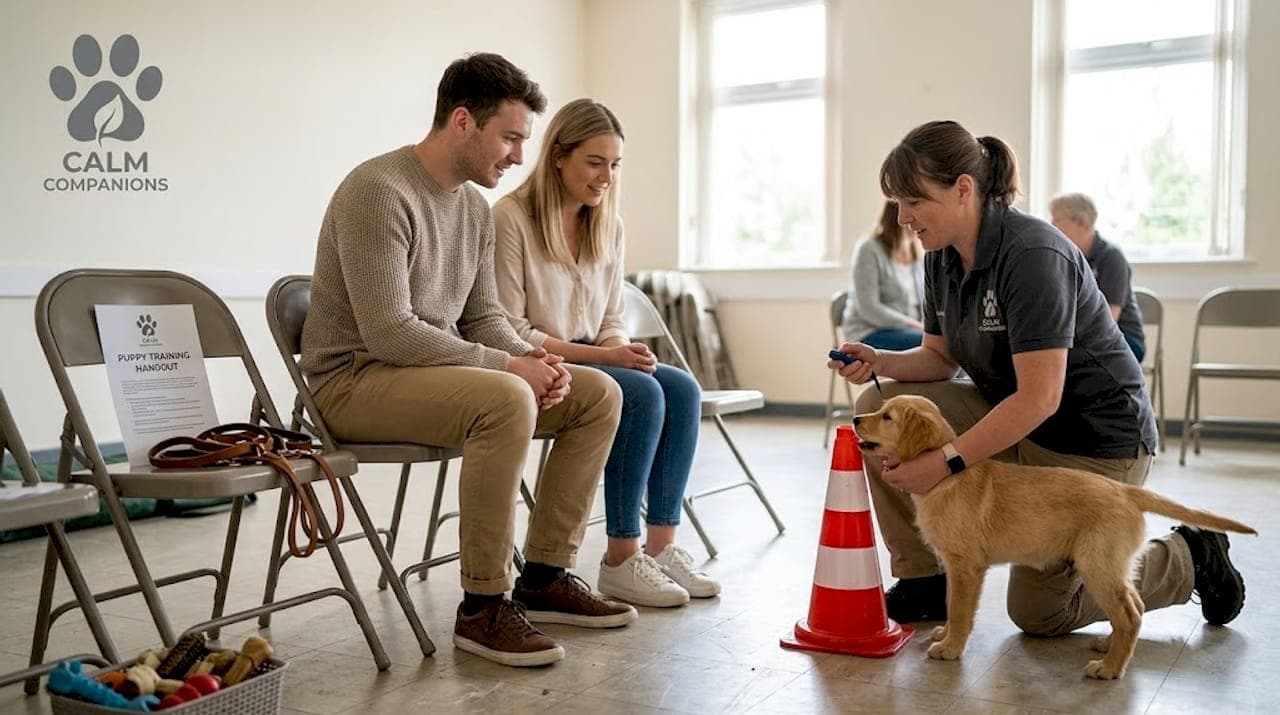
A quality puppy class covers a lot of ground in a short time. The focus is typically on four core areas: socialisation, basic cues, handling, and recall foundations. Each of these matters, but socialisation during the early developmental window is arguably the most time-sensitive.
Research confirms that puppy socialisation classes show empirical evidence of high attendance and likely developmental benefits, particularly in prevention during the key 8 to 16 week window. Miss this window, and catching up becomes significantly harder. That is not a scare tactic; it is simply how canine brain development works.
Here is what a quality class should provide:
- Safe, controlled exposure to other puppies and unfamiliar people
- Positive reinforcement techniques that you can replicate at home
- Guidance on reading your puppy's body language
- Practical handling practice, including ear checks, paw touching, and collar grabs
- Structured recall and name recognition exercises
- Owner education on puppy development, sleep, and nutrition basics
Pro Tip: Before booking, ask the trainer whether the class uses force-free methods. Any class that uses punishment-based tools or techniques is one to avoid. A good trainer will welcome the question.
It is also worth understanding one critical limitation. Skills learned in a class do not automatically transfer to your home, garden, or local park. Your puppy is learning in one specific environment. Teaching them to sit beautifully in a church hall does not mean they will sit calmly when a squirrel runs past the back gate.
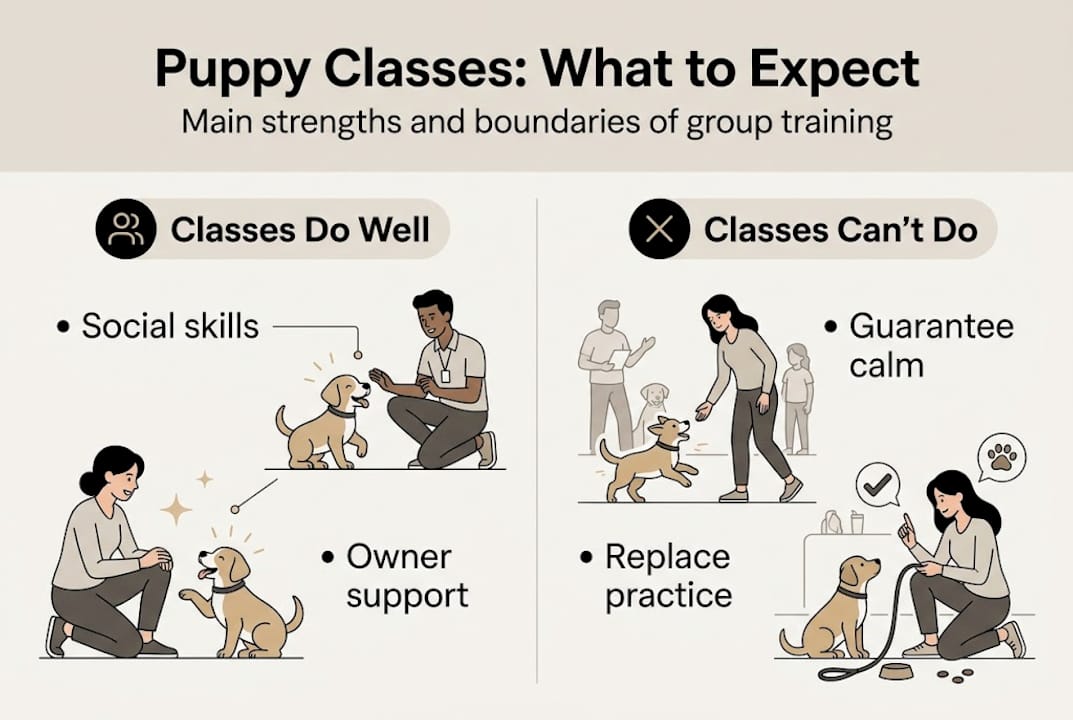
| What classes do well | What classes cannot do alone |
|---|---|
| Socialise puppies safely | Guarantee calm behaviour at home |
| Teach foundation cues | Replace daily practice and consistency |
| Educate owners on technique | Fix existing fear or anxiety |
| Build owner confidence | Generalise skills to every environment |
| Introduce recall foundations | Replace one-to-one behavioural support |
For early puppy training to stick, you need to practise the same cues in multiple environments and contexts. Think of the class as the introduction, and home practice as the real curriculum. These smooth transition tips can help you build that consistency from day one.
The real-world impact: behaviour, socialisation, and misunderstandings
Once you know what's on offer, it's crucial to set clear expectations about real-world results.
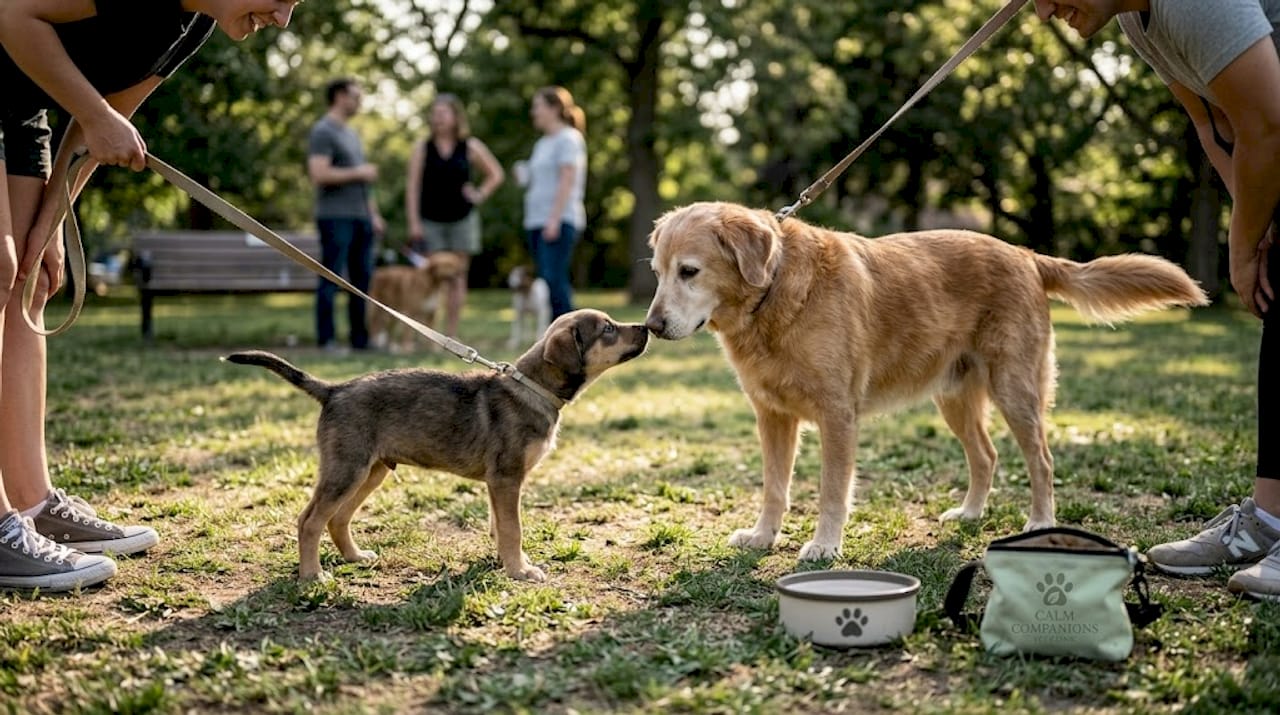
Well-run puppy classes genuinely support social skills. A puppy who meets other dogs, children, and strangers in a safe, positive environment during those early weeks is building an emotional framework for how the world works. That foundation matters enormously. It shapes confidence, tolerance, and curiosity.
But the impact is not uniform across all behaviours. Some skills, like sit and down, tend to generalise reasonably well because they are practised so frequently. Others, particularly impulse control, are far more context-dependent.
Research on self-control development in dogs shows that training does not uniformly improve self-control across all contexts. A puppy who waits patiently for a treat in class may still launch themselves at visitors who arrive at the front door. That is not failure; it is simply how learning works. It requires deliberate practice in every new situation.
Common misconceptions worth addressing:
- One class session will not solve resource guarding or persistent barking
- A well-behaved dog in class does not automatically equal a well-behaved dog everywhere
- Attending classes is not a substitute for understanding pack behaviour in puppies and how your daily interactions shape the relationship
Pro Tip: After each class, spend ten minutes practising the same exercises in three different spots at home: the kitchen, the garden, and the hallway. This rapid-fire variety accelerates generalisation far more than one long practice session in the same spot.
Understanding puppy social cues is also essential. Classes teach your puppy to interact, but you need to read what they are communicating. Stress signals during a class, such as yawning, lip licking, or a tucked tail, mean your puppy is overwhelmed. Recognising these early prevents the session from becoming counterproductive. For broader context, the essential guide to puppy behaviour management is a useful companion read.
Do puppy classes reduce future behaviour problems?
With an understanding of impact, let's see what research says about future behaviour problems and risk reduction.
This is the question most owners really want answered. If I take my puppy to classes, will I avoid the nightmare scenarios further down the line? The honest answer is: partly, and with important caveats.
A study examining dog return rates to UK shelters found no overall reduction in returns as a result of puppy class attendance. That sounds discouraging. But the detail is revealing: the nature of returns shifted. Dogs whose owners attended classes were less likely to be returned for behavioural reasons and more likely to be returned for owner-related reasons such as lifestyle changes or housing.
"Classes may not prevent every dog from being rehomed, but they do appear to reduce the chance of behaviour being the reason."
That is a meaningful distinction. It suggests that classes do improve behaviour outcomes, even if they cannot counteract every life circumstance.
To make the most of the classes you attend, here is a practical action plan:
- Practise every cue taught in class at least once daily in a different environment
- Keep sessions short, between three and five minutes, but do them consistently
- Use the same reward system at home as the trainer uses in class
- Observe your puppy's stress signals and end sessions before they become overwhelmed
- Seek additional puppy obedience training if specific issues persist after class ends
Knowing the puppy behaviour red flags to watch for is also critical. Not every behaviour challenge is simply a training gap; some require specialist input early on.
Classes work best as part of a system, not as the system itself.
Rethinking puppy classes: what most new owners miss
Here is the perspective that rarely gets said plainly enough. The puppy class is not the product. You are the product. Your confidence, your consistency, and your understanding of your puppy's signals are what actually determine the outcome.
The drop-and-go mentality, treating a class like a service you purchase and walk away from, is where most owners quietly go wrong. The trainer can show you the technique, but they cannot make it stick for you. That requires repetition in your kitchen, on your walk, and in every moment your puppy looks to you for direction.
Conventional wisdom says: take the class, follow the homework, done. But the owners we see make the most transformative progress are the ones who combine starting calm training early with home practice and one-to-one support when they hit a wall. That combination is genuinely different in its outcomes compared to any single approach used alone. The class builds knowledge. Home practice builds habit. Individual support builds confidence when things feel uncertain.
How Calm-Companions can support your puppy's journey
If the research in this article has clarified one thing, it is that puppy classes are most effective when supported by consistent home learning and expert guidance along the way. That is exactly what Calm-Companions is here to help with.

Whether you are preparing for your first class, have already attended several sessions, or are still deciding whether classes are right for you, our resources are designed to bridge the gap. From our free puppy help support to our dedicated Week 1 calm support guide, we cover the practical day-to-day challenges that classes simply do not have time to address. If you are wondering how to calm a new puppy in those first overwhelming days, start there.
Frequently asked questions
Are puppy classes necessary for all new puppies?
Not strictly necessary, but they offer real benefits for socialisation and owner confidence, particularly for first-time owners navigating the key developmental window between 8 and 16 weeks.
What age should my puppy start classes?
Most experts recommend starting between 8 and 16 weeks, as this critical developmental period is when socialisation has the greatest and most lasting impact on your puppy's confidence and temperament.
Do puppy classes stop problem behaviours developing later?
Not automatically. Research shows classes can shift the nature of behaviour issues rather than eliminate all risk, so consistent home training and ongoing support remain essential.
Is home training as good as classes?
Home training builds excellent habits, but classes provide supervised socialisation with other puppies and structured guidance from a professional that are genuinely difficult to replicate on your own.