
TL;DR:
- Effective puppy training relies on kindness, consistency, and positive reinforcement techniques.
- Proper preparation and short, frequent sessions boost early learning and confidence.
- Handling setbacks with patience and seeking professional help when needed ensures long-term success.
Bringing a new puppy home is one of life's genuine joys, but within days many first-time owners find themselves exhausted, frustrated, and wondering why their adorable companion seems to ignore every word they say. The biting, the accidents, the chewed shoes — it can feel relentless. The good news is that effective obedience training does not require harsh corrections or complicated methods. Science-backed, kind strategies consistently produce calmer, more confident puppies. This guide breaks down exactly what professionals use, step by step, so you can build real, lasting results from day one without the chaos.
Table of Contents
- What you need to begin: setting up for puppy obedience success
- Step-by-step obedience foundations: proven methods for core commands
- Potty and crate training: house rules every owner should master
- Nipping, chewing, and socialisation: troubleshooting the top puppy hurdles
- Troubleshooting regression and adolescent blips: when puppy training "breaks"
- Why kindness and consistency always outpace quick fixes
- Next steps: unlock a calmer puppy journey
- Frequently asked questions
Key Takeaways
| Point | Details |
|---|---|
| Start early | Begin training as soon as your puppy comes home for the strongest lifelong results. |
| Consistency is key | Use the same schedule, cues, and rewards to help your puppy understand and repeat good behaviours. |
| Focus on positives | Reward wanted behaviours and avoid punishment to build trust and confidence. |
| Adapt to setbacks | Be ready for blips and regression—it’s normal, and retracing steps or seeking help will keep progress on track. |
| Socialise safely | Early, positive exposure to people, pets, and environments helps prevent problems later on. |
What you need to begin: setting up for puppy obedience success
Before you jump into training, you'll need to get the basics organised for both you and your puppy. Preparation is not just helpful — it is the difference between a puppy who learns quickly and one who struggles to focus.
Start by creating a safe, puppy-proofed space. Remove anything chewable or dangerous at floor level, and designate a consistent area where your puppy eats, sleeps, and plays. A predictable environment reduces anxiety and helps your puppy settle faster. You can find more guidance on transition tips for new puppies to support this early stage.
Your essential training toolkit:
- Small, soft training treats (pea-sized, low calorie)
- A clicker or a consistent marker word such as "yes"
- A well-fitted collar or harness and a standard lead
- A crate sized appropriately for your breed
- Chew toys and puzzle feeders to redirect energy
Consistent meal times matter enormously. A puppy fed on a schedule is easier to potty train, more alert during sessions, and less prone to food-guarding habits. Aim for three meals a day for puppies under six months.
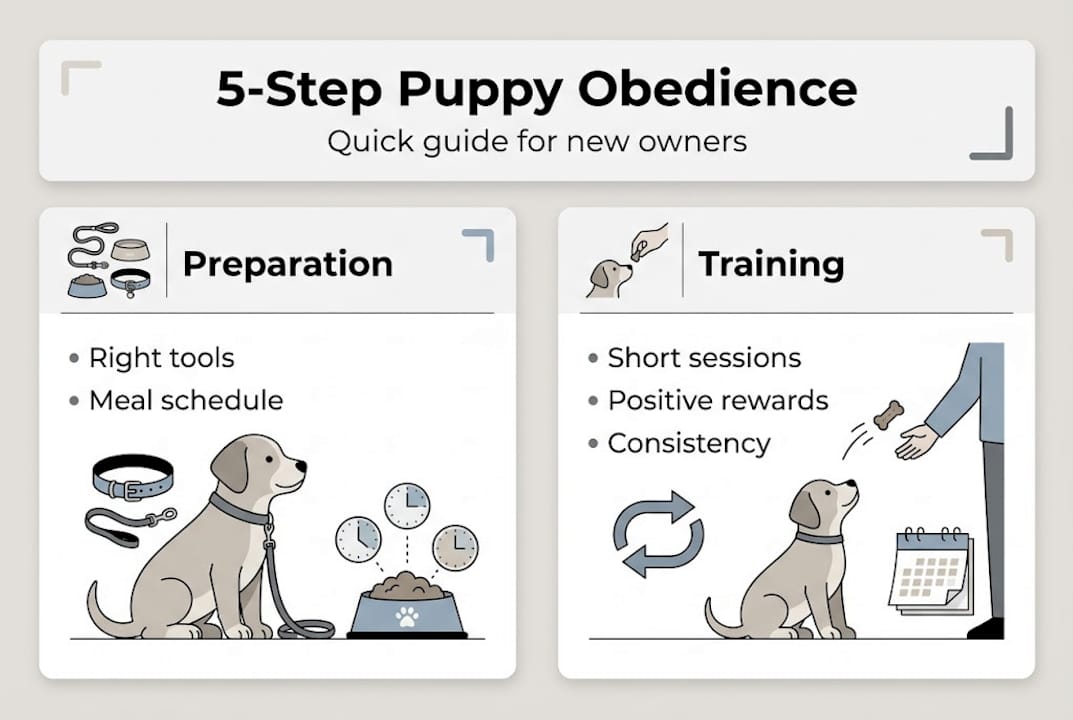
Keep training sessions short. Five to ten minutes, several times a day, is far more effective than one long session. Puppies have limited attention spans, and ending on a positive note keeps them eager to learn. According to puppy training basics, brief, frequent repetition is the cornerstone of early learning.
| Approach | Session length | Frequency | Outcome |
|---|---|---|---|
| Long single session | 30+ minutes | Once daily | Puppy loses focus, slower progress |
| Short, frequent sessions | 5 to 10 minutes | 3 to 5 times daily | Faster learning, better retention |
Timing is also critical. Starting before 16 weeks results in 35% fewer behaviour issues, making those early weeks genuinely precious.
Pro Tip: Train before meals, not after. A slightly hungry puppy is far more motivated by treats and will engage more readily with new commands.
Step-by-step obedience foundations: proven methods for core commands
With your space and tools ready, you're set to teach your puppy the behaviours that lay the foundation for a happy life together. The most reliable method is positive reinforcement: rewarding the behaviour you want so your puppy is motivated to repeat it. Positive reinforcement with treats, toys, and praise is the primary methodology recommended by professional trainers for all core behaviours.
Here is a step-by-step approach for five essential commands:
- Sit: Hold a treat close to your puppy's nose, then slowly move your hand upward. As their bottom lowers, say "sit" clearly, then reward immediately.
- Down: From a sit, lower a treat toward the floor between their front paws. As they follow it down, say "down" and reward.
- Stay: Ask for a sit, then open your palm toward your puppy and say "stay." Take one step back, return, and reward. Gradually increase distance.
- Come: Crouch down, open your arms, and say "come" in a warm, enthusiastic tone. Always reward generously — this command can be life-saving.
- Loose-lead walking: Start indoors. The moment your puppy pulls, stop completely. Only move forward when the lead is slack. Reward frequently for walking beside you.
"The goal is not a perfectly obedient puppy overnight — it is a puppy who trusts you enough to try." Consistency and patience create that trust far faster than any correction.
Never use punishment during these early sessions. Shouting or physical correction risks creating fear and can trigger defensive behaviours. You can explore more about managing difficult moments through puppy behaviour solutions if specific issues arise.
Pro Tip: Always end every session with a command your puppy already knows well. Finishing on success keeps their confidence high and their enthusiasm for the next session strong.
Potty and crate training: house rules every owner should master
Once your puppy learns the basics, mastering where and when to go to the toilet is the next step for a harmonious household. Accidents indoors are not defiance — they are simply a sign that your puppy has not yet learned the rule, or that supervision has slipped.
A reliable potty training schedule is your most powerful tool. Take your puppy outside:
- Immediately after waking up
- Within ten minutes of every meal
- After play sessions
- Every one to two hours during the day
- Last thing at night and first thing in the morning
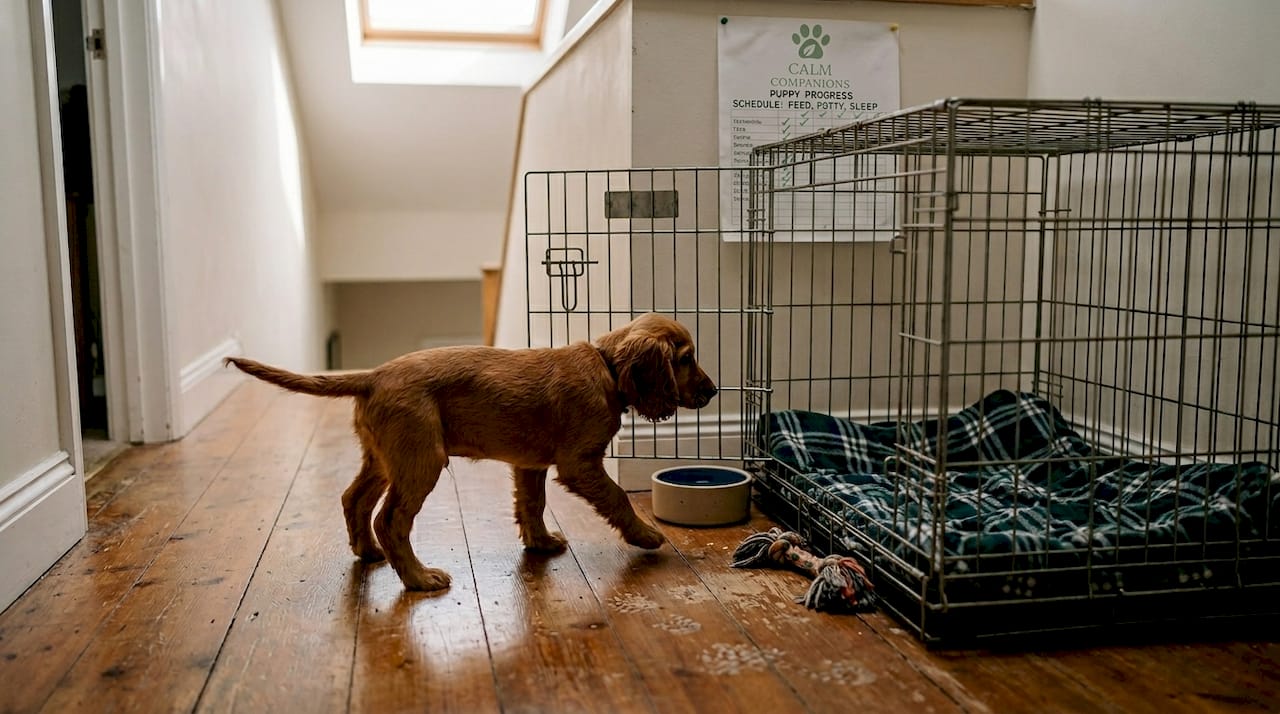
The crate plays a vital supporting role. Dogs instinctively avoid soiling their sleeping area, so a correctly sized crate encourages bladder control. Introduce it gradually using treats and meals inside, never as punishment. According to consistent crate training, this approach yields an 89% to 92% success rate, with most puppies reliably house trained within weeks.
| Puppy age | Bladder control window | Recommended outdoor trips |
|---|---|---|
| 8 to 10 weeks | 1 hour | Every hour |
| 10 to 12 weeks | 2 hours | Every 1.5 hours |
| 3 to 4 months | 3 to 4 hours | Every 2 to 3 hours |
If accidents keep happening despite a solid schedule, check your potty training advice resources and review whether your puppy is getting enough outdoor time and supervision indoors.
Pro Tip: When you catch an accident mid-flow, calmly interrupt with a neutral sound and immediately take your puppy outside. Never scold after the fact — puppies cannot connect a past action to a current consequence.
Nipping, chewing, and socialisation: troubleshooting the top puppy hurdles
Obedience and toilet habits are only part of raising a well-behaved puppy — now let's tackle their teeth and social skills. Most first-time owners are surprised by how hard puppies bite and how much they chew. Both are completely normal behaviours, but both need clear, consistent redirection.
Managing nipping and chewing:
- When your puppy bites too hard during play, let out a short, sharp "ouch" and withdraw attention for thirty seconds
- Rotate chew toys regularly to keep them interesting
- Never use your hands or feet as play objects — this sends a confusing message
- Redirect chewing to appropriate items immediately and reward the swap
- Use baby gates or a playpen to limit access to areas with tempting items
"Bite inhibition — learning how much pressure is acceptable — is one of the most important lessons a puppy learns before twelve weeks."
The sensitive period from 3 to 16 weeks is when redirecting, providing chews, and managing socialisation are most critical for shaping lifelong behaviour. Missing this window makes later correction significantly harder.
Socialisation means calm, positive exposure to different people, sounds, surfaces, animals, and environments. Puppy classes are ideal — they combine structured learning with safe social interaction. Find out more about early socialisation methods to make the most of this window.
For chewing and biting management, the key is consistency across every person in the household. Mixed messages are the most common reason these behaviours persist.
Pro Tip: Carry a chew toy in your pocket during the first few weeks. The moment teeth touch skin, swap immediately. Speed and consistency are everything here.
Troubleshooting regression and adolescent blips: when puppy training "breaks"
Even with the best start, setbacks are normal on the journey — here's how to stay on track if things go awry. Around four to six months, many owners notice their previously compliant puppy suddenly seems to forget everything. This is adolescence, and it is real.
Signs of regression to watch for:
- Ignoring commands they previously knew reliably
- Increased pulling on the lead or jumping up
- House accidents after weeks of success
- Heightened reactivity to other dogs or strangers
Before assuming it is purely behavioural, rule out medical causes. Urinary infections, digestive issues, or pain can all cause sudden house accidents. A vet visit is always worthwhile if regression appears suddenly.
For behavioural regression, return to basics. Revisit earlier training steps, reduce distractions, and increase reward frequency temporarily. Your puppy behaviour management guide has detailed strategies for this phase. If your puppy is also struggling at night, the advice on settling puppy at night can help restore calm routines.
Knowing when to seek professional help is equally important. Professional training classes show a 92% improvement rate for dogs with persistent behavioural challenges. If you spot any serious warning signs, the guide on behavioural red flags outlines exactly when to escalate. And if your training feels like it has completely fallen apart, know that recovery is always possible with the right support.
Why kindness and consistency always outpace quick fixes
So, what truly makes the difference in long-term training success? After reviewing the evidence and working with countless new puppy owners, the answer is always the same: patience, kindness, and repetition beat every shortcut.
Old-school training advice often pushed correction-based methods — a sharp "no," a lead jerk, or worse. These approaches may produce short-term compliance, but punitive methods risk 50% more fear reactions and erode the trust your puppy needs to thrive. A frightened puppy is not a well-trained puppy. It is a puppy waiting for the next bad thing to happen.
Reward-based training, by contrast, builds genuine understanding. Your puppy is not just avoiding punishment — they are actively choosing the behaviour because it works for them. That distinction matters enormously when they face a distraction, a new environment, or a stressful situation. Explore the evidence for positive approaches if you want to read further on this.
Consistency is the quiet hero here. One person using a command correctly while another ignores it completely undoes weeks of progress. Get everyone in your household on the same page, use the same words, and reward the same behaviours. That shared language is what creates a genuinely well-adjusted, confident dog.
Next steps: unlock a calmer puppy journey
If you're ready for sustained progress and support, here's how Calm-Companions can help you turn knowledge into results.
Knowing the theory is one thing — having a practical, day-by-day structure makes all the difference when you are tired and your puppy is testing every boundary. That is exactly what we have built for you.
The Week-1 Puppy Calm Support pack gives you a structured checklist covering routines, night settling, and behaviour management for those critical first days. It is free, practical, and designed specifically for first-time owners who want real results without the overwhelm. Head over to Calm-Companions resources to explore everything available and take the next step toward a calmer, happier home for you and your puppy.
Frequently asked questions
How long should each puppy training session last?
Keep sessions to 5 to 10 minutes, repeated several times throughout the day. Short bursts maintain focus and prevent your puppy from becoming frustrated or disengaged.
At what age should I start puppy obedience training?
Begin as soon as your puppy arrives home. Starting between 8 and 12 weeks gives you the highest retention rates and reduces the likelihood of problem behaviours developing later.
What if my puppy has frequent house accidents despite training?
Review your supervision and outdoor schedule first, but if accidents persist, book a vet check. Medical issues such as urinary infections can mimic training failure and need ruling out before adjusting your approach.
Do I need treats forever to maintain obedience?
No. Once a behaviour is reliable, you can gradually replace treats with praise and life rewards such as a game or a walk. Treats are a teaching tool, not a permanent requirement.
Is punishment ever necessary for puppy training?
No. Punishment increases fear and problem behaviours rather than solving them. Positive reinforcement is consistently safer, more effective, and builds the trust that makes long-term obedience possible.