
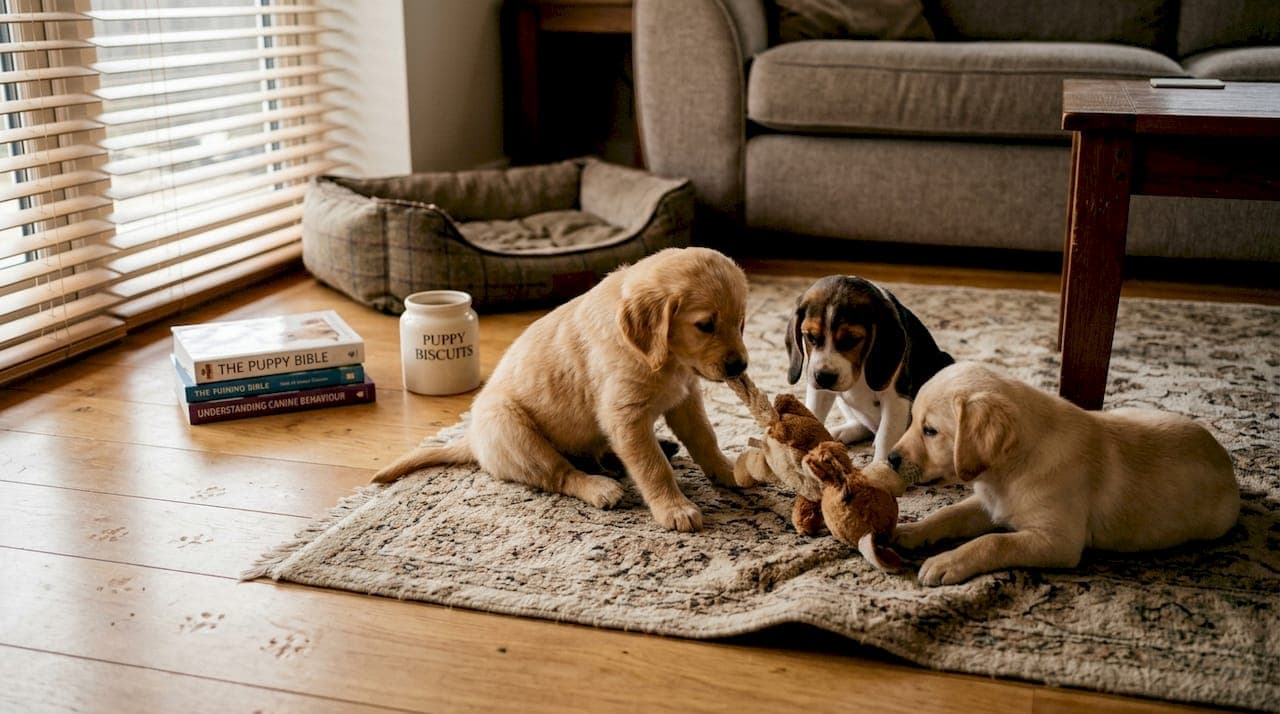
You've just brought your puppy home, and already you're wondering why they're nipping at your ankles, growling over their food bowl, or refusing to settle at night. Many new owners assume their puppy is trying to "dominate" them, a belief rooted in the old "alpha dog" theory. The good news is that modern science debunks these strict dominance hierarchies, which were based on flawed studies of captive wolves. Understanding how puppy pack behaviour actually works gives you a far more effective, kinder toolkit for training and settling your new companion.
Table of Contents
- What is puppy pack behaviour?
- Recognising puppy pack behaviour in your home
- Myths and realities: alpha dog, family pack, and positive leadership
- Practical strategies for establishing healthy pack structure
- Troubleshooting: common edge cases and what to do
- Support for new puppy owners
- Frequently asked questions
Key Takeaways
| Point | Details |
|---|---|
| Pack behaviour origins | Puppy pack behaviour comes from wolf ancestry but needs modern, science-backed interpretation for family dogs. |
| Positive leadership wins | Clear communication and positive reinforcement are far more effective for puppy settling and training than dominance methods. |
| Practical structure | Consistent routines, crate training, and resource management help new puppies adapt and thrive. |
| Avoid aggression pitfalls | Supervision and structure prevent play turning aggressive, especially in multi-dog homes. |
What is puppy pack behaviour?
Puppy pack behaviour refers to the instinctive social tendencies your puppy inherited from its wolf ancestors. In the wild, wolves live in family groups with a loose social structure, not a battlefield of constant power struggles. When your puppy joins your household, it looks for similar social cues: who provides safety, who controls resources, and where it fits in.
Pack behaviour in dogs describes these instinctive social dynamics, where dogs form hierarchies with leaders and followers, and your family, including every human in the home, becomes part of that social unit. This is actually useful information. It means your puppy is wired to follow clear, consistent leadership. The challenge is providing that leadership in a way that builds trust rather than fear.
Here is a quick comparison of the old and new thinking:
| Old alpha theory | Modern science |
|---|---|
| Dogs constantly compete for dominance | Dogs seek social structure and safety |
| Owners must "dominate" their dog | Owners guide through consistency and trust |
| Force and punishment establish rank | Positive reinforcement builds lasting behaviour |
| Hierarchy is rigid and fixed | Social roles are flexible and context-dependent |
Key things to understand about pack behaviour in your home:
- Your puppy is not plotting to overthrow you. It is looking for guidance.
- Humans are viewed as part of the social group, not a separate species to outsmart.
- Clear routines signal safety and reduce anxiety in young dogs.
- Leadership is about calm consistency, not physical dominance.
For a practical starting point, the puppy calm support checklist offers a structured week-one plan that aligns perfectly with these principles.
Recognising puppy pack behaviour in your home
Knowing what pack behaviour looks like in daily life helps you respond appropriately rather than accidentally reinforcing the wrong habits. Some behaviours are completely normal. Others are early warning signs worth addressing straight away.
Common signs of pack dynamics playing out at home include:
- Resource guarding: Growling or stiffening when approached near food, toys, or sleeping spots.
- Attention-seeking: Pawing, nudging, or barking to demand interaction on their terms.
- Challenging older dogs: Testing boundaries with resident pets through persistent pestering or posturing.
- Handler interaction: Mouthing, jumping, or ignoring commands when they sense inconsistency.
Here is a quick reference for distinguishing normal play from concerning behaviour:
| Behaviour | Normal play | Worth addressing |
|---|---|---|
| Mouthing | Soft, relaxed jaw | Hard biting, not releasing |
| Chasing | Mutual, both dogs take turns | One dog always fleeing |
| Growling | Playful, body loose | Stiff body, fixed stare |
| Resource response | Moves away when asked | Snaps or lunges |
Recognising these signs early, such as handler aggression or resource guarding, and responding with consistent leadership, routines, and obedience training from day one, makes a significant difference. The key is not to punish these behaviours harshly but to redirect and establish clear expectations.
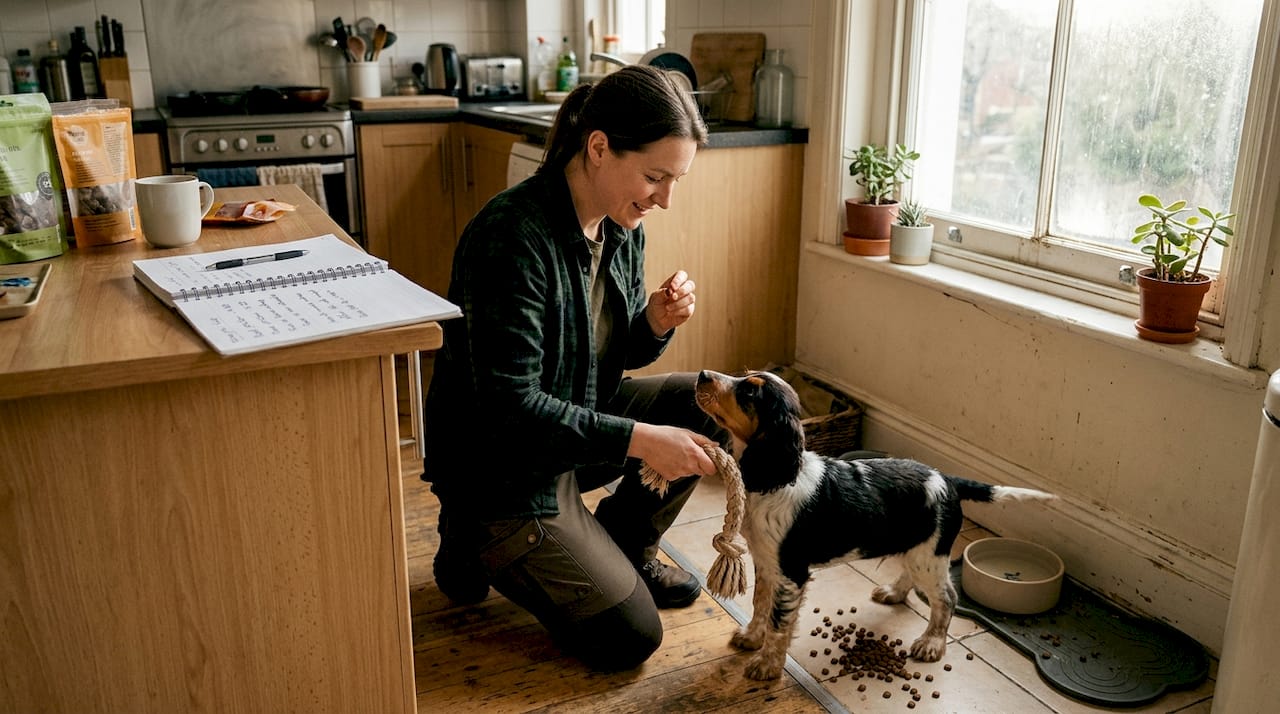
It is also worth noting that dogs thrive on positive reinforcement, clear communication, and trust-based leadership rather than dominance, and force-based methods can actively harm your relationship. Stocking up on the right tools from the start helps enormously. Browse puppy essentials to make sure you have everything in place before problems arise.
Pro Tip: Keep a simple behaviour diary for the first two weeks. Noting when and where certain behaviours occur helps you spot patterns and address triggers before they become habits.
If you are feeling overwhelmed, free help for puppy owners is available to guide you through the early days.
Myths and realities: alpha dog, family pack, and positive leadership
The "alpha dog" concept became enormously popular in the 1970s and 1980s, largely through television and popular dog training books. The idea was simple: dogs are wolves, wolves have alphas, therefore you must be the alpha. It felt logical. It was also wrong.
Wild wolves are family units with cooperative parenting, not groups locked in constant competition. The original research that inspired the alpha theory was conducted on unrelated captive wolves forced together under stress, a situation that bears no resemblance to how dogs actually live with humans.
Here is what the evidence actually supports:
- Positive reinforcement produces faster learning and longer-lasting behaviour change.
- Dogs trained with force or intimidation show higher rates of anxiety and aggression.
- Cooperative, trust-based relationships reduce problem behaviour significantly.
- Consistency and predictability matter far more than physical dominance.
"Dogs do not form rigid packs with humans. They thrive on positive reinforcement, clear communication, and trust-based leadership. Force-based methods can harm relationships." — ASPCA
It is fair to say there is still debate. Traditional trainers advocate pack leadership for certain behaviour problems, while experts at organisations like the AKC and ASPCA favour science-based positive training, viewing alpha methods as outdated and potentially risky. For new puppy owners, the science-backed approach is both safer and more effective.
Pro Tip: If someone advises you to "pin" your puppy or use physical corrections to establish rank, that is a red flag. Seek science-based training help instead.
Practical strategies for establishing healthy pack structure
Understanding the theory is one thing. Applying it at home, with a wriggly, excitable puppy who has just discovered your sofa, is another matter entirely. Here are the steps that actually work.
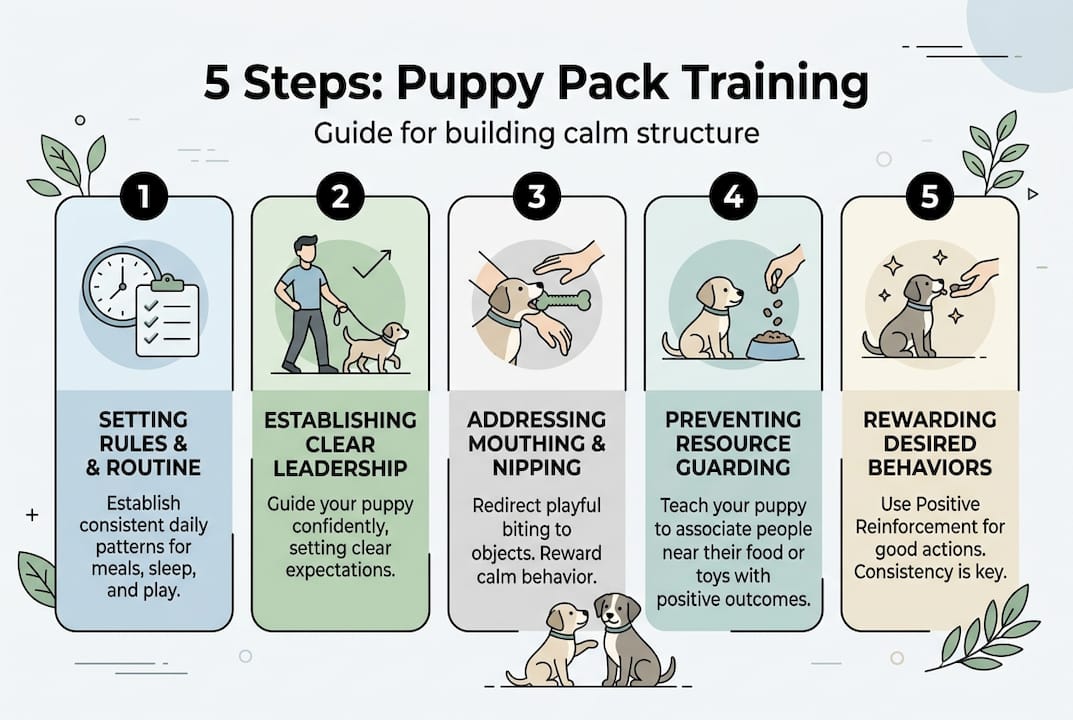
- Control resources calmly. Food, walks, and attention are your most powerful tools. Ask for a sit before meals, before going outside, and before play. This is not about dominance. It is about teaching your puppy that good things come from engaging with you.
- Use a crate as a safe space. A crate is not a punishment. Used correctly, it gives your puppy a den-like retreat that reduces anxiety and prevents destructive behaviour when unsupervised.
- Establish a daily routine. Puppies settle faster when they can predict what happens next. Fixed times for feeding, toileting, play, and sleep reduce stress enormously.
- Prioritise the socialisation window. The critical socialisation period runs from 3 to 16 weeks. Positive exposure to people, sounds, surfaces, and other animals during this window shapes long-term behaviour more than almost anything else you will do.
- Supervise multi-dog interactions. If you have an older dog, do not assume they will sort things out between themselves. Structured introductions and supervised play prevent the formation of bad habits early.
Establishing yourself as a calm leader through groundwork, controlling resources, requiring sits for attention, using crates for management, and supervising multi-dog interactions, sets the foundation for a well-adjusted adult dog.
The week-1 puppy calm support guide walks you through each of these steps in a manageable daily format. Pair it with the puppy essentials list to make sure your home is set up for success from the very first day.
Pro Tip: Short, frequent training sessions of three to five minutes work far better than long ones. Puppies have limited attention spans, and ending on a success keeps motivation high.
Troubleshooting: common edge cases and what to do
Even with the best preparation, challenges arise. Here are the most common ones and how to handle them.
Adding a new puppy to a home with existing dogs is one of the trickiest situations. Relentless play can turn aggressive when there is no structure in place, and weak leadership causes dogs to assume roles that lead to stress, warnings, or outright fights. Introduce dogs on neutral ground, keep initial sessions short, and always supervise.
Common mistakes to avoid:
- Leaving a new puppy and resident dog alone together too soon.
- Allowing the puppy to pester the older dog without intervention.
- Feeding both dogs in the same space without supervision.
- Assuming growling from the older dog is always aggression. It is often a legitimate correction.
When play turns rough, look for signs like one dog always on the bottom, yelping that is not reciprocated, or a dog trying to escape but being prevented. Step in calmly, separate briefly, and allow both dogs to settle before reintroducing.
Leadership gaps are another common issue. When owners are inconsistent, puppies fill the vacuum. This is not malice. It is instinct. Consistent schedules, crate training, supervision, and positive methods ease the transition and prevent fear-based issues from taking hold.
Pro Tip: If tension between dogs keeps escalating despite your efforts, consult a qualified behaviourist early. Problems that are addressed at eight weeks are far easier to resolve than those left until eight months.
For ongoing support and practical tools, free help for puppy owners is just a click away.
Support for new puppy owners
Understanding puppy pack behaviour is the first step. Putting it into practice, day after day, with a tired puppy and a busy household, is where most owners need a helping hand.
Calm-Companions has built a set of practical resources specifically for this moment. The week-1 puppy calm support guide gives you a structured daily plan covering routines, night settling, and behaviour management so nothing falls through the cracks. The puppy essentials checklist ensures your home is properly prepared before your puppy even arrives. And if you need more targeted guidance on training, puppy training help connects you with science-backed advice tailored to your situation. You do not have to figure this out alone.
Frequently asked questions
Does every puppy try to 'dominate' its new family?
No. Most puppies are simply seeking structure and reassurance, not control. The alpha dominance myth has been thoroughly debunked by modern animal behaviour science, and acting on it can actually create the fear-based behaviour you are trying to avoid.
How do I stop aggressive play between my puppy and older dogs?
Supervise all interactions closely, intervene before play escalates, and use consistent routines to reduce competition and tension. Relentless unstructured play between a new puppy and a resident dog is one of the most common triggers for aggression in multi-dog households.
What is the critical window for puppy socialisation?
The crucial period runs from 3 to 16 weeks of age. The AKC highlights this window as the time when positive experiences with people, animals, and environments have the greatest lasting impact on your puppy's social development.
Can force-based leadership harm my puppy?
Yes, it can. Force-based methods risk damaging the trust between you and your puppy and can increase anxiety and problem behaviour over time. Positive reinforcement is not just kinder, it is more effective and produces more reliable results.