
TL;DR:
- Puppies at 8 to 10 weeks already show memory and communication skills that influence their future temperament.
- Early training focuses on routines, calm space, short focus exercises, and gradual social exposure.
- Tailoring training to individual puppy traits and owner emotional states enhances long-term calmness and confidence.
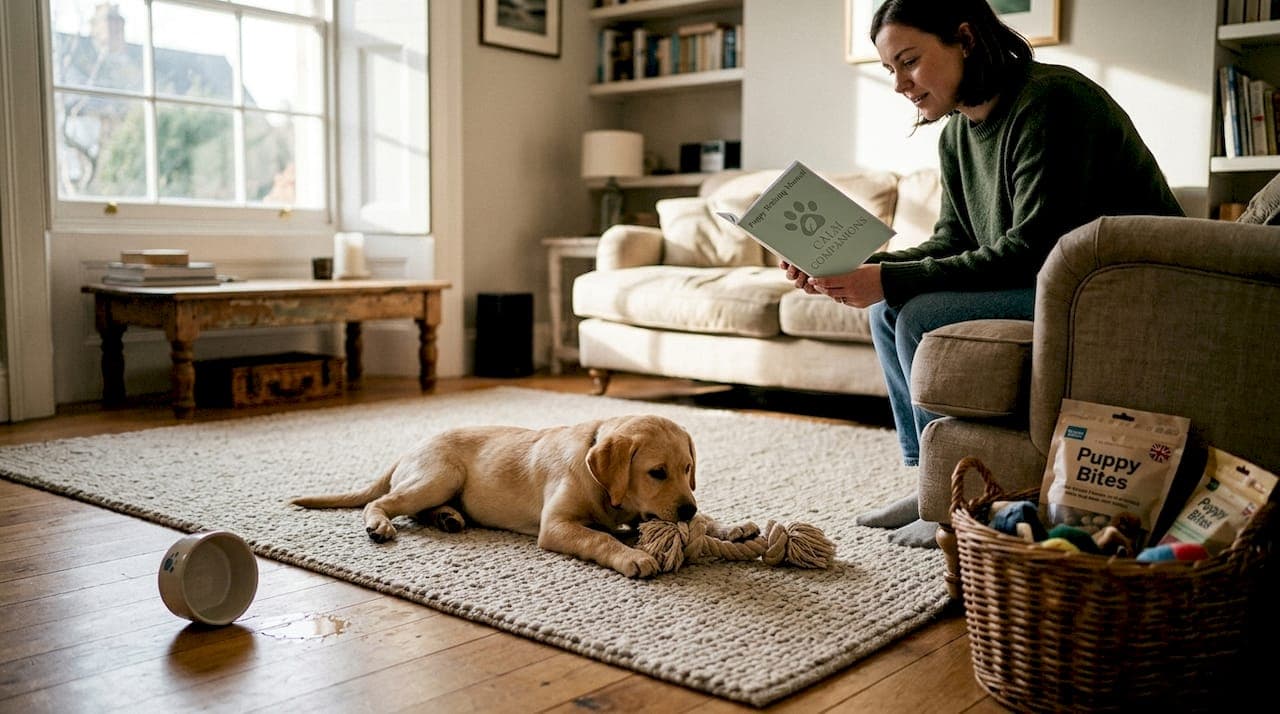
Most new puppy owners assume serious training begins at three or four months. In reality, puppies at 8–10 weeks already show measurable memory, discrimination skills, and early communication abilities. That means every interaction in your puppy's first days at home is already shaping their future temperament. The good news is that starting early does not mean complicated. Simple, consistent actions in week one can set the foundation for a calmer, more confident dog. This guide walks you through the science, the practical techniques, and the honest truths that most puppy guides leave out.
Table of Contents
- How early learning shapes puppies: science and outcomes
- Practical techniques: creating calm and confidence from week one
- Comparing approaches: classes versus home-based training
- Tailoring training: focusing on puppy personality and needs
- What most guides miss about early puppy training
- Support for your calm puppy journey
- Frequently asked questions
Key Takeaways
| Point | Details |
|---|---|
| Start early for success | Beginning puppy training from week one lays the groundwork for a calm, confident dog. |
| Tailor training methods | Adapting techniques to your puppy’s personality and needs uncovers optimal results. |
| Combine structured and flexible approaches | Using both classes and home-based methods helps puppies socialise and learn at their own pace. |
| Consistency beats complexity | Regular, simple routines are more effective in shaping lasting calm behaviours than complicated programmes. |
How early learning shapes puppies: science and outcomes
There is a common belief that puppies are blank slates until they complete their vaccinations and join a formal class. Science tells a very different story. Early cognition emerges by 16 weeks, and crucially, impulse control developed during this window predicts how calm a dog will be as an adult. That is not a small detail. It means the habits you build now echo for years.
Researchers working with assistance dog candidates found memory and discrimination abilities in puppies at a mean age of just 9.2 weeks. These pups could follow short delay tasks and respond to human communication cues far earlier than previously assumed. If puppies being assessed for demanding roles can learn at this age, your puppy at home absolutely can too.
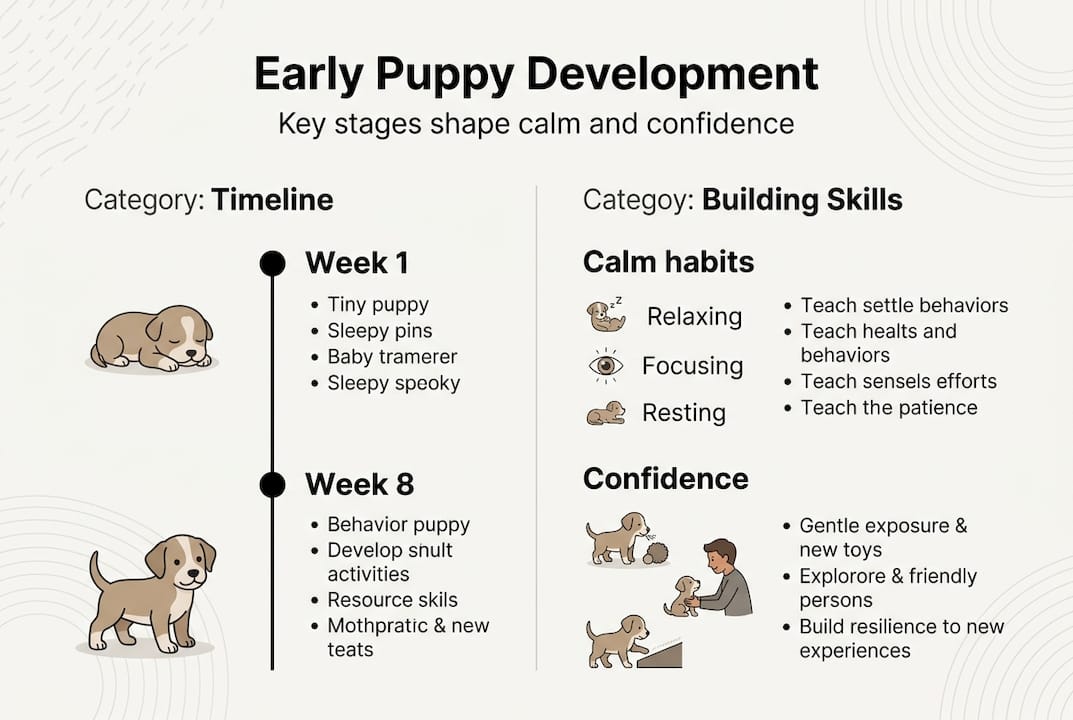
Here is a quick overview of what the research tells us about key developmental windows:
| Developmental stage | Age range | What is being shaped |
|---|---|---|
| Socialisation window | 3–12 weeks | Fear responses, trust, social bonds |
| Early cognition | 8–16 weeks | Memory, communication, discrimination |
| Impulse control | 12–20 weeks | Self-regulation, calm behaviour |
| Habit formation | Ongoing from week 1 | Routines, responses to cues |
What this means practically is that puppy behaviour training during weeks one through four at home is not just warm-up. It is the main event.
Key things shaped by early learning include:
- Response to human cues: Puppies learn to read your body language and tone very quickly.
- Tolerance for being alone: Brief, calm separations early on prevent separation anxiety later.
- Reaction to novel stimuli: Early positive exposure reduces fearful responses to new sounds and environments.
- Impulse control: Short focus exercises now build the self-regulation that creates a calm adult dog.
Pro Tip: Keep early training sessions to two or three minutes maximum. Puppies have short attention spans, and ending on a success is far more powerful than pushing through until they lose focus.
The science also shows that tailoring your approach to your individual puppy matters. A bold, confident puppy needs different handling than a cautious, sensitive one. Week-1 calm support that accounts for your puppy's specific traits will always outperform a one-size-fits-all approach. Understanding this early makes building trust with puppies a much smoother process for both of you.
Practical techniques: creating calm and confidence from week one
Knowing that puppies learn early is one thing. Knowing exactly what to do about it is another. The first week at home can feel chaotic, but a handful of focused techniques make an enormous difference to how your puppy settles.
Here is a step-by-step framework for week one:
- Set a predictable daily rhythm. Feed, toilet, play, and rest at consistent times. Puppies regulate their nervous systems through routine far more than through commands.
- Introduce short, positive focus exercises. Ask your puppy to make eye contact before placing their food bowl down. This simple act begins teaching impulse control without any formal training required.
- Create a calm settling space. A crate or pen with familiar-smelling bedding gives your puppy a place to decompress. Calm does not happen by accident; it needs an environment that supports it.
- Practise brief, positive separations. Step out of the room for 30 seconds, return calmly, and repeat. This builds tolerance for alone time before it becomes a problem.
- Use your voice deliberately. A soft, steady tone during calm moments and a brighter, upbeat tone during play teaches your puppy to read your emotional state as a cue.
One important finding from recent research is that training does not uniformly boost self-control across all contexts. A puppy that learns to wait patiently for their food bowl may still struggle with impulse control in a high-excitement environment like a park. This is not failure. It means you need to practise calm behaviour in multiple settings, not just at home.
Common mistakes owners make in week one:
- Overwhelming the puppy with visitors. Too much social stimulation in the first days raises stress hormones and disrupts settling.
- Responding to whining at night with immediate attention. This teaches the puppy that noise brings reward.
- Skipping rest periods. Overtired puppies are reactive puppies. Enforced naps are not cruel; they are essential.
Pro Tip: If your puppy seems overwhelmed, reduce the environment rather than increasing reassurance. Dimming lights, reducing noise, and giving them their safe space works faster than cuddles.
For a fuller picture of how to set up your puppy's first days, puppy transition tips offer practical, week-by-week guidance. If you want to go deeper on enhancing puppy self-control, there are structured resources available to help. And if you feel your puppy needs more specific input, personalised training help is worth exploring early rather than waiting for problems to appear.
Comparing approaches: classes versus home-based training
Once you have a handle on week-one basics, the question of formal training naturally comes up. Should you join a puppy class, train at home, or do both? The honest answer depends on your puppy, your lifestyle, and what each option actually offers.
The numbers are telling: 67% of owners attend puppy classes, and attendance is associated with first-time owners and those who received information packs from their vet or breeder. However, the research also shows that classes vary considerably in structure, play time, and training methods. Attending a class does not guarantee a consistent or evidence-based experience.
Here is a direct comparison of the two main approaches:
| Factor | Puppy classes | Home-based training |
|---|---|---|
| Socialisation with other dogs | High | Low unless arranged separately |
| Flexibility of timing | Low | High |
| Consistency of method | Varies by instructor | Fully within your control |
| Cost | Moderate to high | Low |
| Exposure to distractions | High | Gradual and controlled |
| Tailoring to your puppy | Limited | Fully tailored |
Puppy classes offer something home training cannot replicate easily: controlled exposure to other dogs and people in a structured setting. For socialisation, this is genuinely valuable. A puppy that only ever trains at home may struggle to apply calm behaviour in busier environments.
Home training, on the other hand, allows you to move at your puppy's pace, repeat exercises as often as needed, and build confidence without the pressure of performing in front of others.
The most effective approach for most owners is a combination: use classes for socialisation and structured exposure, and use home training for consistency, routine, and tailored impulse control work.
When choosing a class, look for:
- Positive reinforcement methods only (no punishment or correction-based techniques)
- Small group sizes so your puppy gets individual attention
- Structured play alongside formal exercises to balance stimulation and learning
- A clear curriculum rather than open-ended socialisation sessions
For more on getting the early environment right, introducing your puppy to their new home thoughtfully is the foundation everything else builds on. You can also explore puppy class essentials and access free puppy advice to help you make an informed choice.
Tailoring training: focusing on puppy personality and needs
Every puppy is different. A Border Collie and a Cavalier King Charles Spaniel will not respond to the same training pace, the same level of stimulation, or the same type of reward. Recognising your puppy's individual traits is not a luxury; it is what separates effective training from frustrating guesswork.
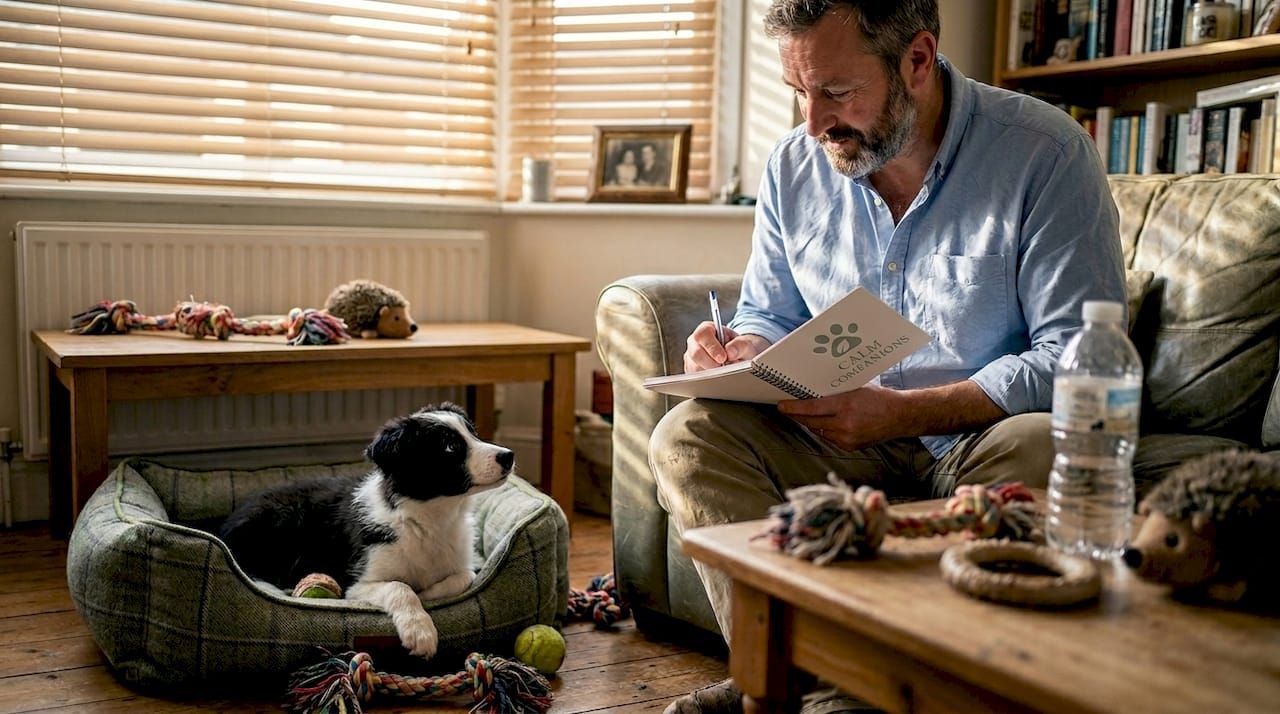
Research confirms that tailoring training to puppy traits predicts smoother transitions and better long-term outcomes. This makes intuitive sense. A sensitive puppy pushed too hard too fast will shut down or become anxious. A bold, high-drive puppy given too little stimulation will find their own entertainment, usually in ways you will not enjoy.
Signs your puppy may need a more tailored approach:
- Freezing or hiding during training sessions (indicates overwhelm, slow down)
- Unable to settle after exercise (indicates under-stimulation or insufficient routine)
- Hyper-fixating on food rewards to the point of losing focus (indicates high food drive, use smaller rewards)
- Ignoring food rewards entirely during training (indicates stress or low food motivation, try play rewards)
- Reacting strongly to sounds or movement (indicates sensitivity, build exposure very gradually)
Breed tendencies matter too. Herding breeds often need mental challenges alongside physical exercise. Scent hounds are easily distracted by smells and need shorter, more focused sessions outdoors. Toy breeds can be more sensitive to tone of voice and benefit from extra-gentle handling during early training.
Pro Tip: Spend the first three days simply observing your puppy before introducing formal exercises. Note what excites them, what worries them, and how long they can focus before switching off. This information is worth more than any training manual.
Adapting your methods does not mean lowering your expectations. It means meeting your puppy where they are and building from there. If you are unsure where to start, custom training help can provide a structured starting point based on your puppy's specific profile.
What most guides miss about early puppy training
Most puppy guides focus on techniques. Sit, stay, recall, crate training. These are useful, but they miss the deeper truth: the most powerful variable in early puppy training is not the method. It is you.
Puppies are extraordinarily sensitive to human emotional states. A tense, anxious owner creates a tense, anxious puppy. We see this repeatedly. Owners who approach training with calm confidence, even if they make technical mistakes, tend to produce calmer dogs than those who apply textbook methods with underlying anxiety or frustration.
Consistency matters more than complexity. A simple routine repeated calmly every day will outperform an elaborate training programme delivered inconsistently. Most guides also underplay how much the owner's own regulation affects outcomes. Before you ask your puppy to be calm, check your own state.
The other thing guides miss is that puppy behaviour secrets are rarely secrets at all. They are basic principles applied with patience and adaptability. No single method works for every puppy. The owners who succeed are the ones who stay curious, adjust when something is not working, and prioritise the relationship over the result.
Support for your calm puppy journey
The first week with a new puppy moves fast, and it is easy to feel like you are always one step behind. The practical steps in this guide give you a strong foundation, but having structured support makes a real difference to how smoothly everything comes together.
At Calm-Companions, we have put together resources specifically designed for this exact moment in your puppy's life. Our free Week-1 puppy checklist covers daily routines, night settling, and behaviour management in a simple, day-by-day format. If you want hands-on guidance, our expert puppy training connects you with specialists who understand early development. And for everything you need to set up a calm home environment, our puppy essentials bundle has you covered from day one.
Frequently asked questions
What is the best age to start puppy training?
Puppies at 8–10 weeks already demonstrate memory and communication skills, so starting structured training from the very first week at home is ideal rather than waiting for a formal class.
Do puppy classes or home training work better?
Both have genuine strengths; 67% of owners attend classes for socialisation benefits, while home training offers consistency and flexibility, and combining both tends to produce the best outcomes.
Are all puppies equally responsive to training techniques?
Training does not uniformly boost self-control across all contexts or breeds, and tailoring training to puppy traits consistently predicts smoother adjustment and calmer long-term behaviour.
How can I tell if my puppy is adjusting calmly?
Look for relaxed body posture during rest, willingness to engage with training, and growing confidence in new situations; early cognition predicts calm behaviour and these signs reflect that development is on track.
Recommended
- Calm-Companions | Week-1 Puppy Calm Support (Free Checklist)
- Essential puppy transition tips for a stress-free start
- Calm leadership for puppies: Build trust and ease transitions
- Website Home Draft | Calm-Companions
- Puppy Obedience Basics: Building Safe Connections – iPupPee
- Dog Training at Home: Achieve Calm, Obedient Companions