

TL;DR:
- Puppies struggle at night due to separation anxiety, overstimulation, and unfamiliar environments.
- Common mistakes include late play, inconsistent routines, and rushing to comfort, which hinder settling.
- Gentle routines, comfort items, and proximity help puppies settle faster and build lifelong trust.
Most new puppy owners expect the first night to be tough, but few expect it to be this tough. The crying, the pacing, the 3am wake-ups that leave you questioning every decision you made. What catches people off guard is that a tired puppy does not automatically mean a sleeping puppy. Settling at night is a skill your puppy needs to learn, and it requires more than exhaustion to make it happen. In this guide, we cover why puppies genuinely struggle at night, the mistakes that make things worse, and the practical techniques that actually help you both get some rest.
Table of Contents
- Understanding why puppies need settling at night
- Common mistakes new owners make at night
- Effective techniques for settling your puppy
- Troubleshooting problems if your puppy won't settle
- A fresh perspective: Why setting your puppy up for night matters more than you think
- Helpful next steps for new puppy owners
- Frequently asked questions
Key Takeaways
| Point | Details |
|---|---|
| Night routines are crucial | Settling your puppy at night helps prevent anxiety and supports healthy habits. |
| Consistency is key | Routine actions every night help puppies feel safe and secure during transitions. |
| Avoid common mistakes | Overstimulating or ignoring anxiety can make settling more difficult for your puppy. |
| Practical strategies work | Simple techniques and gradual comfort-building are proven to support calm nights. |
Understanding why puppies need settling at night
Before you can fix the problem, it helps to understand what is actually going on in your puppy's world once the lights go out.
Puppies are born into a pile. Littermates provide warmth, sound, and constant physical contact from the very first day of life. When your puppy arrives home, all of that disappears in one afternoon. The familiar smells are gone. The sounds are different. The warmth of siblings has been replaced by a quiet room and a strange new bed. It is a significant sensory shift, and nighttime is when it hits hardest.
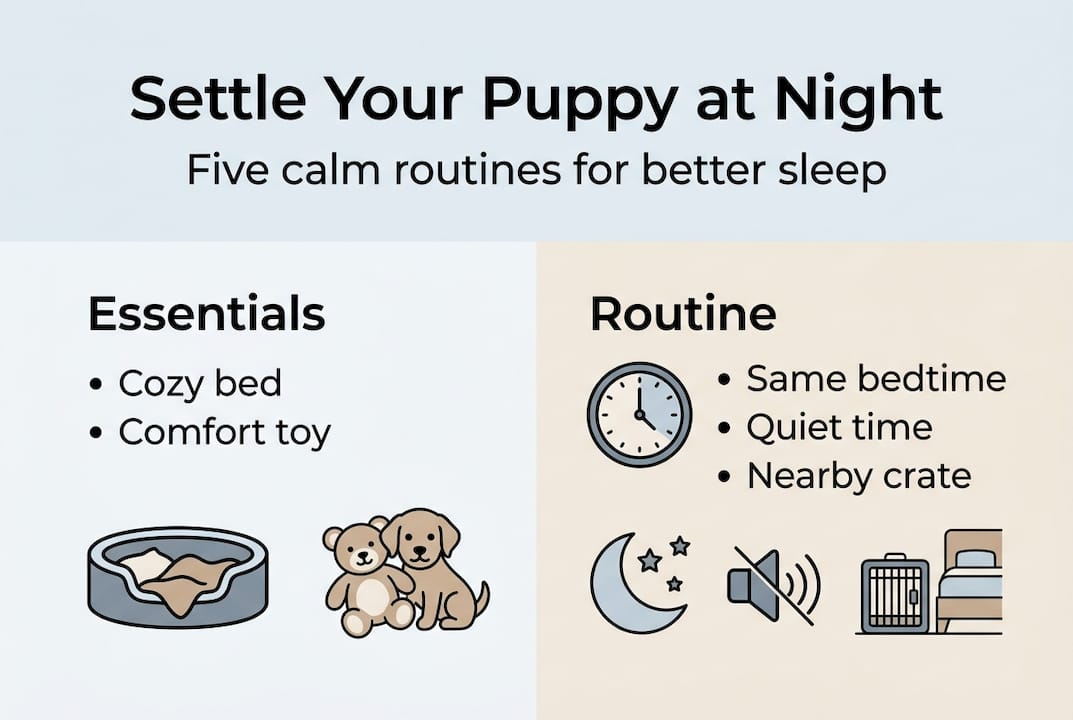
Puppies experience heightened anxiety at night due to separation from their litter and new environments, which explains why even a puppy who seemed calm during the day can become distressed the moment you leave the room.
Here are the most common reasons puppies struggle to settle at night:
- Separation anxiety: Being alone feels genuinely threatening to a social animal that has never slept solo
- Overstimulation: A busy first day means a nervous system that is still buzzing long after you switch the lights off
- Unfamiliar environment: New smells, sounds, and surfaces create low-level alertness that prevents deep sleep
- Hunger or discomfort: Young puppies have small stomachs and may need a late feed or toilet break
- Lack of routine: Without predictable cues, puppies cannot anticipate what comes next, which keeps them on edge
One of the biggest misconceptions is that a physically tired puppy will simply crash. In reality, an overtired puppy is often more difficult to settle, not less. Exhaustion in young dogs can tip into hyperactivity and anxiety rather than calm sleep.
"A puppy's nervous system is still developing, and without the right environment and cues, rest simply does not come naturally."
For more on managing the early days, our puppy transition advice covers the full picture of what to expect in week one. You can also find practical guidance on introducing your puppy to your home in a way that reduces stress from the very start.
Common mistakes new owners make at night
Now we understand why settling is needed, let us look at mistakes to avoid.
Good intentions can accidentally make nighttime harder. Most of the errors new owners make come from a place of love, but they create patterns that work against your puppy's ability to settle independently.
Here are the most common nighttime mistakes:
- Late play sessions: Energetic play in the hour before bed raises adrenaline and makes it much harder for your puppy to wind down
- Erratic routines: Feeding, walking, and bedtime at different times each night removes the predictability puppies rely on to feel safe
- Rushing to comfort every sound: Responding immediately to every whimper can teach your puppy that crying is the way to get attention, reinforcing the behaviour
- Changing the sleeping location: Moving your puppy from room to room each night prevents them from forming a settled association with one space
- Skipping a pre-bed toilet trip: A puppy that needs the toilet cannot settle, no matter how calm the environment is
Overstimulating puppies before bedtime can disrupt their ability to settle, which is why the hour before bed should be quiet, predictable, and low energy.
Pro Tip: Consistency is the single most powerful tool you have. A puppy who goes to bed at the same time, in the same place, after the same routine will settle faster than one whose evenings are unpredictable. Even small variations, like feeding 30 minutes later than usual, can shift the whole night.
It is also worth checking that your puppy's sleeping area includes the right puppy essentials for comfort and security. A well-chosen bed, appropriate warmth, and familiar scent items make a real difference to how quickly your puppy accepts their space.

For broader behaviour tips for puppy training, understanding how routine shapes behaviour early on is one of the most valuable lessons you can take away from the first few weeks.
Effective techniques for settling your puppy
Having avoided the common mistakes, let us move into proven settling techniques.
Structured routines and gradual comfort-building at night lead to faster settling for puppies, and the good news is that these techniques are straightforward to apply once you know what you are doing.
Here is a simple step-by-step settling method for the first weeks:
- Wind down an hour before bed: Swap play for calm interaction. Gentle stroking, quiet time together, or simply sitting near your puppy works well.
- Last toilet trip: Take your puppy outside or to their toilet spot immediately before settling them for the night.
- Place them in their sleeping area: Do this calmly and without fuss. A brief, warm phrase like "bedtime" said consistently helps build a verbal cue over time.
- Add a comfort item: A worn t-shirt or a warm (not hot) covered water bottle can mimic the warmth and scent of littermates.
- Leave without drama: Prolonged goodbyes increase anxiety. A calm, quiet exit is always better.
When it comes to where your puppy sleeps, each option has trade-offs:
| Sleeping option | Pros | Cons |
|---|---|---|
| Crate beside your bed | Feels secure, easy to hear them | Requires crate training first |
| Open bed in your room | Comfortable, close to you | Less boundary-setting |
| Separate room from the start | Builds independence faster | Can increase initial distress |
For most new owners, a crate or enclosed bed placed close to you for the first few weeks is the most effective starting point. Darkness, warmth, and a consistent low-level white noise source (such as a radio on low) can all support faster settling. The puppy calm support checklist outlines exactly how to set this up night by night.
Troubleshooting problems if your puppy won't settle
If problems persist, here is how to troubleshoot and respond.
Some puppies take longer than others, and that is completely normal. The key is knowing the difference between typical adjustment behaviour and signs that something needs to change.
Signs of normal adjustment:
- Whimpering for 10 to 15 minutes before settling
- Waking once or twice in the night for a toilet break
- Restlessness in the first three to five nights
Signs that need attention:
- Persistent crying for more than 30 minutes with no sign of settling
- Refusal to eat or drink in the evening
- Visible shaking, panting, or frantic behaviour
Here is a quick troubleshooting reference for the most common nighttime problems:
| Problem | Likely cause | What to try |
|---|---|---|
| Crying that does not stop | Anxiety or discomfort | Move sleeping area closer to you temporarily |
| Frequent night waking | Needs toilet or is cold | Add a toilet break; check warmth of sleeping area |
| Refusing to go into crate | Negative association | Practise daytime crate time with treats and praise |
| Waking very early | Light or noise disturbance | Use blackout curtains; try white noise |
Pro Tip: If your puppy is consistently waking at the same time each night, that is a pattern, not a coincidence. Adjust your routine around that time rather than fighting it. Gradually push the wake-up later by 10 to 15 minutes every few nights.
Many puppies need routine adjustment and additional emotional support to overcome stubborn settling issues, so do not hesitate to seek free puppy advice if you feel stuck. The early weeks are the most important time to get the foundations right, and support is available.
A fresh perspective: Why setting your puppy up for night matters more than you think
The most common piece of advice passed down through generations of dog owners is to let your puppy cry it out. The logic seems sound: they will learn that crying does not work, and eventually they will stop. But this approach misunderstands what a puppy is actually experiencing.
A young puppy left to cry alone is not learning independence. They are learning that the world is unpredictable and that distress goes unanswered. That lesson can shape behaviour for months, sometimes years. We have seen it repeatedly at Calm-Companions: owners who pushed through the crying in week one often come back in month three dealing with separation anxiety, destructive behaviour, or a dog that cannot be left alone at all.
Gentle, consistent routines are not about spoiling your puppy. They are about building a nervous system that knows how to be calm. Expert guidance and consistent practice can significantly reduce transition anxiety for puppies, and the investment you make in those first two weeks pays dividends for the entire life of your dog. The nights feel long right now. But the habits you build tonight are the ones your dog carries forward.
Helpful next steps for new puppy owners
Getting the first nights right is one of the most impactful things you can do for your puppy's long-term wellbeing, and you do not have to figure it out alone.

At Calm-Companions, we have put together a free puppy calm support checklist that walks you through exactly what to do each night in your puppy's first week at home. It covers settling routines, comfort techniques, and practical night-by-night guidance so you always know what to do next. If you run into problems along the way, our training help resources are there to support you with targeted advice for the most common settling challenges. Sign up, follow the plan, and give both you and your puppy the best possible start.
Frequently asked questions
How long does it take for a puppy to settle at night?
Most puppies take between a few days and two weeks to settle, depending on routine consistency and their temperament. Structured routines and gradual comfort-building are the fastest route to reliable nighttime rest.
Is it better to let my puppy cry at night or comfort them?
Comforting your puppy gently is more effective for reducing anxiety and building trust, compared to letting them cry it out. Consistent practice and expert guidance show that responsive settling produces calmer dogs in the long run.
Where should my puppy sleep during the first weeks?
A safe, comfortable space near you, such as a crate beside your bed, is recommended for the first weeks. Heightened anxiety at night means proximity to you makes a significant difference to how quickly your puppy settles.
What if my puppy keeps waking up for the toilet?
Young puppies may need night toilet breaks; gradually reducing them as your puppy learns cues and routine is key. Routine adjustment and emotional support help puppies build the bladder control and confidence to sleep through.
Recommended
- Calm-Companions | Week-1 Puppy Calm Support (Free Checklist)
- How to introduce your puppy to home: 7 expert steps
- Essential puppy transition tips for a stress-free start
- Puppy pack behaviour: smoother training in 5 steps
- How to calm a dog: proven techniques for anxious pets – iPupPee
- 6 Effective Pet Calming Techniques for Urban Dog Owners – Teddy Pet