
TL;DR:
- The first night is stressful for puppies, but normal signs include whining and restlessness.
- Creating a calm, predictable environment with routines helps puppies feel safe and settle quicker.
- Consistent, patient handling and avoiding quick fixes build lifelong confidence in puppies.
Bringing a new puppy home is one of the most exciting things you can do, but the first night often tells a very different story to the one you imagined. Many new owners believe that a warm bed and a full belly will be enough to send their puppy straight off to sleep. In reality, most puppies spend those early hours whining, pacing, or refusing to settle at all. That is not a sign that something is wrong with your puppy or your home. It simply means your puppy is a puppy. With the right structure, a little patience, and some evidence-backed guidance, the transition can be far smoother than you might expect.
Table of Contents
- Understanding your puppy's first days at home
- Creating a calm and secure environment
- Calm-Companions framework: routine and reassurance
- Common settling challenges and expert solutions
- Why quick fixes rarely deliver lifelong calm
- Support and further resources from Calm-Companions
- Frequently asked questions
Key Takeaways
| Point | Details |
|---|---|
| First days set the tone | A calm, structured approach during your puppy’s first days helps establish lifelong positive behaviour. |
| Consistency calms stress | Routines and predictable environments are crucial in helping puppies settle and feel secure. |
| Watch for warning signs | Early recognition of red flags like excessive crying or aggression enables rapid, effective intervention. |
| Leverage expert resources | Accessing guides and checklists such as Calm-Companions increases owner confidence and puppy wellbeing. |
Understanding your puppy's first days at home
Before you can help your puppy settle, it helps to understand what they are actually going through. Think about it from their perspective. One day they are sleeping in a warm pile with their littermates, surrounded by familiar smells and sounds. The next, they are in a completely different environment, with new people, new textures underfoot, new noises, and no siblings in sight. That is a significant emotional shift for a very young animal.
Puppies are not being naughty when they whine, pace, or refuse to eat in those first days. They are communicating confusion and anxiety. Puppy behaviour basics explain that these responses are entirely normal and are rooted in the puppy's instinct to seek safety and connection. Understanding that context changes everything, because it means your job is not to discipline the behaviour away. Your job is to provide enough structure and reassurance that your puppy starts to feel safe.
Common stress signals to watch for in the first few days:
- Persistent whining or crying, especially at night
- Restlessness and an inability to settle in one place
- Loss of appetite or reluctance to drink water
- Toileting indoors even after being taken outside
- Excessive panting or trembling without physical cause
- Hiding behind furniture or avoiding eye contact
As puppy behaviour management guidance notes, whining and restlessness are typical during first nights and should not immediately cause alarm. The key is knowing the difference between normal adjustment stress and something more serious.
| Behaviour | Likely cause | What to do |
|---|---|---|
| Whining at night | Separation from littermates | Calm reassurance, not isolation |
| Refusing food | Anxiety or overwhelm | Offer small amounts, keep it quiet |
| Accidents indoors | Stress or unfamiliar signals | Increase toilet trips, stay patient |
| Hiding or cowering | Fear of new environment | Give space, avoid forcing interaction |
| Excessive chewing | Anxiety or boredom | Provide safe chew toys, limit space |
The first few days genuinely do lay the foundation for everything that follows. A puppy who learns early that their environment is safe and predictable will grow into a more confident, calmer dog. A puppy who experiences those early days as chaotic or unpredictable may carry that anxiety forward into adolescence and beyond. It is worth investing your energy here.
"The way a puppy experiences their first week at home shapes their emotional baseline for months to come. Calm, consistent handling in this period is not a luxury. It is a necessity."
If you notice any behaviours that feel more extreme, such as complete refusal to eat for more than 24 hours, or signs of physical distress, it is worth checking in with red flags in behaviour to understand when to take things more seriously.
Creating a calm and secure environment
Once you understand how your puppy feels, it is time to put practical, calming strategies in place. The good news is that the changes you need to make are not complicated. They are mostly about consistency and thoughtful setup.
Start with your puppy's sleeping area. A designated, enclosed space, such as a crate or a puppy pen with soft bedding, gives your puppy a clear signal about where they belong. Puppies are den animals by instinct, and a snug, enclosed space often feels more reassuring than a large open room. Place the sleeping area somewhere quiet but not completely isolated, ideally where your puppy can still hear household sounds without being in the middle of them.

Familiar scents make a significant difference. If possible, ask the breeder or rescue centre for a small piece of bedding that smells of your puppy's mother or littermates. Placing this in the sleeping area during the first few nights can reduce distress noticeably. You can also wear a soft cloth for a day and then place it in the crate, so your scent becomes associated with comfort.
Practical steps for setting up a calming environment:
- Use a crate or pen that is large enough to stand and turn in, but not so large it feels exposed
- Line it with washable bedding and a familiar scent item
- Place a covered hot water bottle (not too hot) under the bedding for warmth on the first few nights
- Keep the area away from busy foot traffic, televisions, and loud appliances
- Introduce your puppy to each room gradually rather than giving full access immediately
- Avoid having lots of visitors in the first few days, no matter how excited friends and family are
Routine and consistent environments are key to calming new puppies, and this applies to the physical space just as much as the daily schedule. A puppy who always eats in the same spot, sleeps in the same area, and is taken outside via the same route will feel the world becoming more predictable. Predictability is calming.
Pro Tip: Overstimulation is one of the most overlooked causes of puppy distress. Young puppies need far more sleep than most owners realise, often up to 18 hours per day. If your puppy is becoming snappy, frantic, or impossible to settle, the answer is usually more rest, not more play.
Introducing gentle stress-free routine tips from day one, including set feeding times, regular toilet trips outside, and short, calm play sessions, helps your puppy's nervous system begin to regulate. Keep early interactions calm and positive, and resist the urge to overwhelm your puppy with excitement, even if you are thrilled to have them home.
Calm-Companions framework: routine and reassurance
With your puppy's environment set up, let's get practical by walking through a tried-and-tested routine framework. The Calm-Companions approach is built on three layers: routine, predictability, and positive association. Each layer builds on the last, and together they create the conditions for lasting calm.
Routine means doing the same things at roughly the same times each day. Feeding, toileting, play, and rest should all follow a recognisable pattern. Your puppy cannot read a clock, but they are extremely good at reading patterns, and a predictable pattern tells them the world is safe.
Predictability goes beyond timing. It means your responses are consistent too. If your puppy whines and sometimes you come running and sometimes you do not, they learn that the world is unpredictable. Calm, consistent responses, even when the behaviour is challenging, build trust faster than any reward.
Positive association means pairing the things your puppy finds uncertain, such as the crate, being alone, or new sounds, with good experiences. A treat dropped into the crate before your puppy goes in, a calm voice when they hear the hoover for the first time, a gentle stroke after a toilet trip outside. Small moments, repeated consistently, build a confident dog.
As calming steps for puppies highlight, combining structure with reassurance is essential for harmonious puppy behaviour during the settling period.
A simple daily schedule for the first week:
- Wake up, immediate toilet trip outside, calm praise for going
- Small breakfast in the designated feeding spot
- Short, gentle play session of around ten minutes
- Rest period in crate or pen for 60 to 90 minutes
- Toilet trip, then a brief exploration of one room
- Lunchtime feed, followed by another rest period
- Afternoon play, toilet trip, more rest
- Evening meal, toilet trip, calm wind-down before bed
| Inconsistent approach | Structured approach |
|---|---|
| Feeding at different times each day | Fixed feeding times morning and evening |
| Puppy roams freely from day one | Gradual introduction to rooms over days |
| Reacting differently to whining each night | Calm, consistent response every time |
| Play when it suits the owner | Short, timed play sessions throughout the day |
| No clear bedtime signal | Same wind-down routine each evening |
Pro Tip: The wind-down routine matters enormously. A short walk, a final toilet trip, and then settling into the crate with a chew or a stuffed Kong signals to your puppy that the day is ending. Repeat this sequence every evening and your puppy will begin to anticipate sleep rather than resist it. You can find more detail on calming puppies in practice through the Calm-Companions guides.
Common settling challenges and expert solutions
After outlining the Calm-Companions settling framework, let's troubleshoot what to do if things are not progressing as smoothly as you hoped. Even with the best preparation, some puppies take longer to settle, and some owners hit specific stumbling blocks that feel impossible to move past.
The most common challenges and what to try:
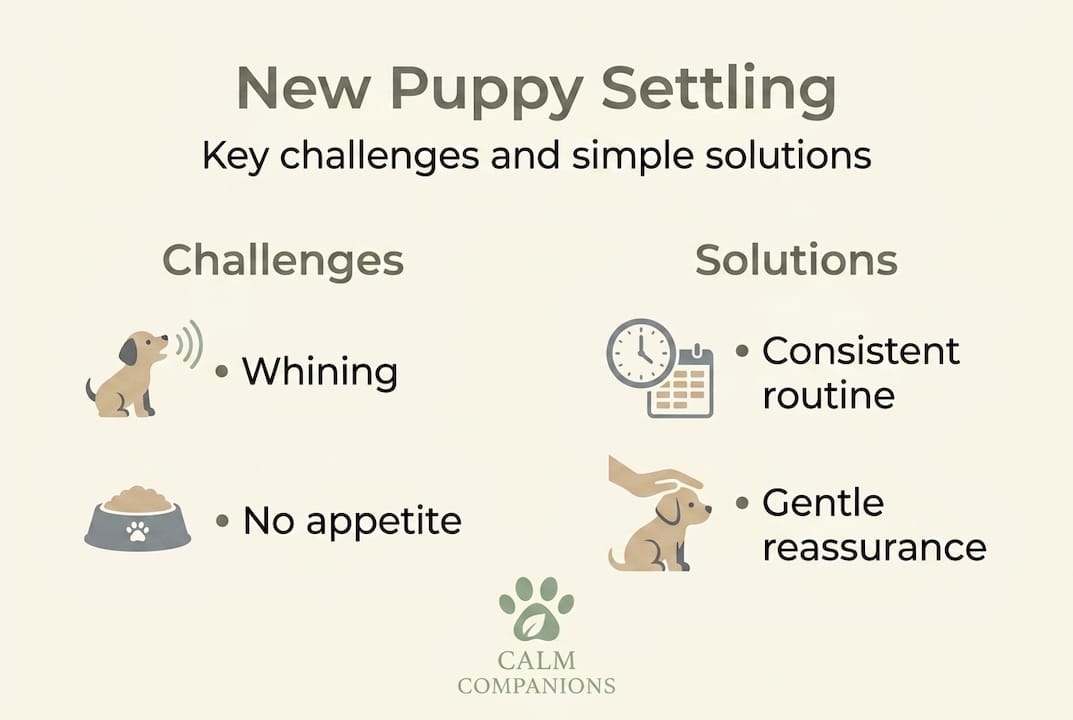
- Persistent night-time whining: Check the crate is warm enough, that your puppy has been to the toilet recently, and that the sleeping area is not too isolated. Moving the crate closer to your bedroom for the first week can reduce distress significantly without creating a long-term habit.
- Accidents despite regular toilet trips: Increase the frequency of outdoor trips, especially after meals, naps, and play. Puppies often need to go every 30 to 45 minutes when they are very young. Avoid punishing accidents indoors, as this increases anxiety and slows progress.
- Destructive chewing: This is almost always a sign of anxiety, boredom, or too much unsupervised space. Reduce the area your puppy has access to, increase mental stimulation through safe chew toys, and ensure rest periods are adequate.
- Refusing food: Offer smaller, more frequent meals and keep the environment quiet at mealtimes. If refusal continues beyond 24 hours, contact your vet.
"The owners who struggle most in the first weeks are usually the ones trying to solve behaviour problems in isolation, rather than addressing the environment and routine that is driving them."
Recognising red flag behaviours early can prevent long-term issues from taking hold. There is a meaningful difference between a puppy who whines for 20 minutes at bedtime and gradually settles, and a puppy who shows signs of genuine panic, such as frantic scratching, vomiting, or complete inability to rest at any point during the day. The first is normal adjustment. The second warrants attention.
If you feel your puppy's behaviour is escalating rather than improving after the first two weeks, do not wait. Training steps for puppies can offer structured next steps, and seeking guidance from a qualified behaviourist or trainer is always a sensible move when you are unsure. Acting early is always better than waiting for a problem to become entrenched.
Why quick fixes rarely deliver lifelong calm
Here is something the internet rarely tells you. Most of the "miracle" solutions you see on social media, the one-night crate training hacks, the viral settling techniques, the celebrity trainer tricks, work for some puppies some of the time. They are not solutions. They are shortcuts that occasionally land well.
Genuine, lasting calm in a dog comes from weeks of reliable patterns, not a single clever trick on night one. The behaviour management depth required to raise a confident, well-adjusted dog is not dramatic or complicated. It is quiet and consistent. It is the owner who does the same bedtime routine on a Tuesday in week four as they did on the first night home.
What social media gets wrong is that it shows outcomes without showing the process. You see the calm dog. You do not see the three weeks of patient, repetitive work that created it. Owners who invest in understanding their puppy's behaviour, who use structured resources and stay consistent even when progress feels slow, raise happier dogs. That is not opinion. That is simply what the evidence shows, and what we see reflected in the owners who come to us having done the groundwork properly.
Support and further resources from Calm-Companions
The guidance in this article gives you a strong foundation, but having structured, week-by-week support makes a real difference when you are in the thick of those first days.
At Calm-Companions, we have built our resources specifically for new puppy owners navigating this exact period. Our free settle-in checklist walks you through your puppy's first week day by day, covering night settling, routine building, and early behaviour management in one easy-to-follow format. You can also explore our full range of Puppy Help resources for guidance beyond week one. If you want ongoing support and reassurance as your puppy grows, Week-1 Calm Support is a great place to start your journey with us. You do not have to figure this out alone.
Frequently asked questions
How long does it take for a new puppy to settle in?
Most puppies settle within two to three weeks, though this varies depending on their age, background, and how consistently structure is provided at home.
What is the best routine for calming a new puppy?
A consistent routine with fixed feeding, toileting, and rest times helps puppies feel secure quickly, as routine and consistent environments are directly linked to reduced anxiety in new puppies.
Which behaviour signs mean my puppy is too stressed?
Continual whining, refusing food, destructive chewing, and repeated indoor toileting can all indicate excessive stress, and as noted in puppy behaviour guidance, whining and restlessness that do not ease over several days deserve closer attention.
Should I let my puppy cry at night?
Responding with calm, quiet reassurance rather than ignoring distress entirely helps your puppy build trust and feel safe, which leads to more settled nights over time.
When should I seek professional help with puppy settling?
If distress continues beyond the first two weeks or your puppy displays significant warning signs, red-flag behaviours that persist are a clear signal to seek expert guidance sooner rather than later.