
TL;DR:
- Gentle, consistent leadership based on trust and positive reinforcement is most effective for puppies.
- Old dominance methods are flawed, create fear, and are replaced by science-backed, trust-building techniques.
- Start leadership early, between 8-10 weeks, and adapt approaches to your puppy's personality for best results.
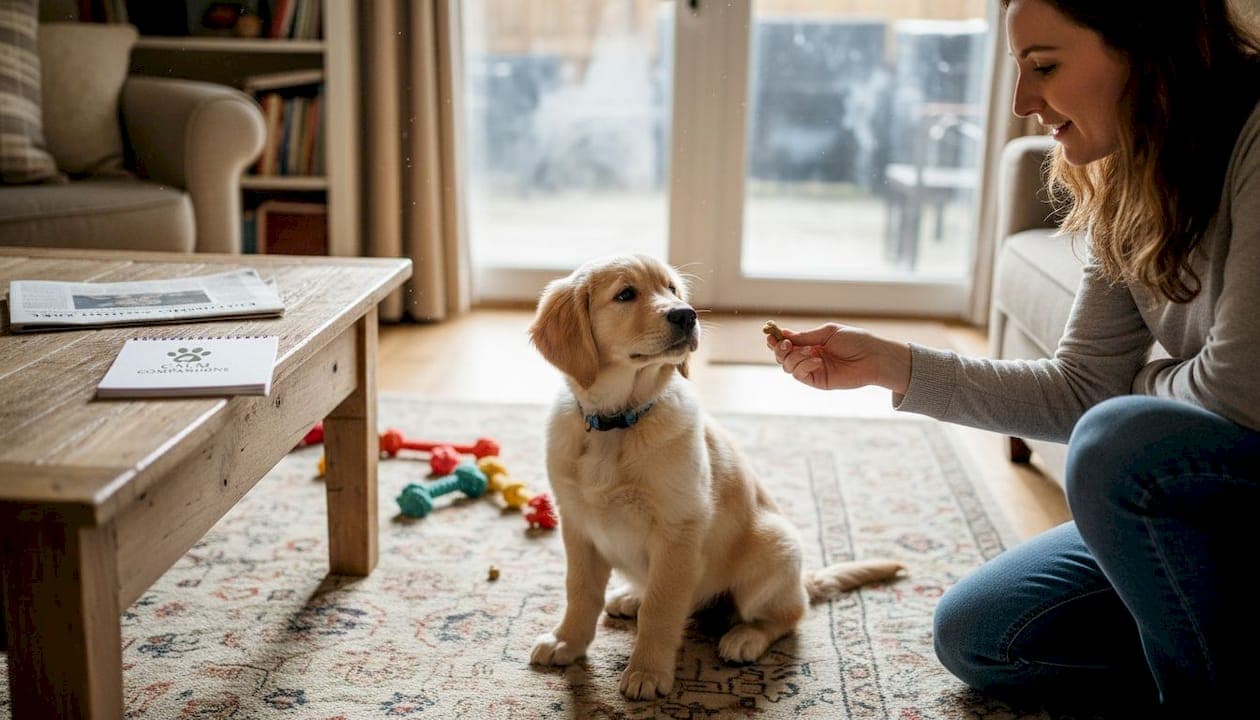
Many new puppy owners arrive home convinced that being a good leader means being firm, authoritative, and in control at all times. That instinct is understandable, but it is built on a foundation of outdated dominance myths that modern science has firmly set aside. Real puppy leadership is something far gentler and, frankly, far more effective. It is about being a consistent, calm presence your puppy can rely on. This article will show you exactly what that looks like, why the evidence supports it, and how to put it into practice from the very first day your puppy arrives home.
Table of Contents
- What does puppy leadership really mean?
- The science behind puppy behaviour and leadership
- Practical puppy leadership: everyday examples
- Adapting leadership to your puppy's personality
- Why old 'dominance' methods fail and gentle leadership works
- Find expert support for puppy leadership
- Frequently asked questions
Key Takeaways
| Point | Details |
|---|---|
| Leadership is guidance | Effective puppy leadership means consistent, gentle guidance rather than dominance or control. |
| Positive methods work best | Evidence supports that positive, reward-based techniques foster trust and faster learning in puppies. |
| Start early for harmony | Beginning leadership and clear routines from day one helps your puppy settle and prevents future issues. |
| Tailor approach to puppy | Adapting your leadership style to suit your puppy’s personality ensures better results and a happier relationship. |
What does puppy leadership really mean?
The word "leadership" carries a lot of baggage. For decades, dog training culture was saturated with the idea that you needed to dominate your dog, assert yourself as the "alpha," and establish a strict pack hierarchy. It sounded logical. It felt decisive. The problem is that it was based on flawed captive wolf studies that have since been thoroughly debunked by researchers studying wolves in the wild, most notably by biologist L. David Mech. Wild wolf families do not operate on dominance hierarchies. They function more like cooperative family units, and modern experts now firmly reject the dominance model for dogs.
So what does genuine puppy leadership look like? Think of it less like a military commander and more like a trusted teacher. Your puppy is not trying to take over the household. It is simply trying to understand the world, and it needs you to provide clear, consistent signals about what is safe, what is expected, and where the boundaries lie.
"Leadership in dog training is not about control or dominance. It is about being a reliable, calm guide that your dog can trust and look to for direction."
Evidence from positive reinforcement research consistently shows that dogs trained with reward-based methods learn faster and form stronger bonds with their owners. Both the American Veterinary Medical Association and the American Veterinary Society of Animal Behaviour endorse positive techniques over dominance-based approaches.
The core traits of effective puppy leadership include:
- Consistency: Responding the same way every time so your puppy can predict outcomes
- Calmness: Keeping your own energy steady, especially during challenging moments
- Clarity: Using simple, repeatable cues your puppy can learn quickly
- Patience: Allowing your puppy time to process and respond without pressure
- Positive reinforcement: Rewarding the behaviours you want to see more of
If you want to explore this further, our guide on calm leadership for puppies walks through the trust-building process in detail.
The science behind puppy behaviour and leadership
Understanding why gentle leadership works requires a brief look at what is actually happening inside your puppy's brain during those early weeks at home.
Research published in Frontiers in Ethology confirms that dogs show deferential behaviour toward humans from a remarkably early age, as young as three to eight weeks. Unlike wolves, domestic dogs have evolved over thousands of years to look to humans for guidance. Your puppy is not wired to fight you for control. It is wired to follow your lead, provided you give it something worth following.
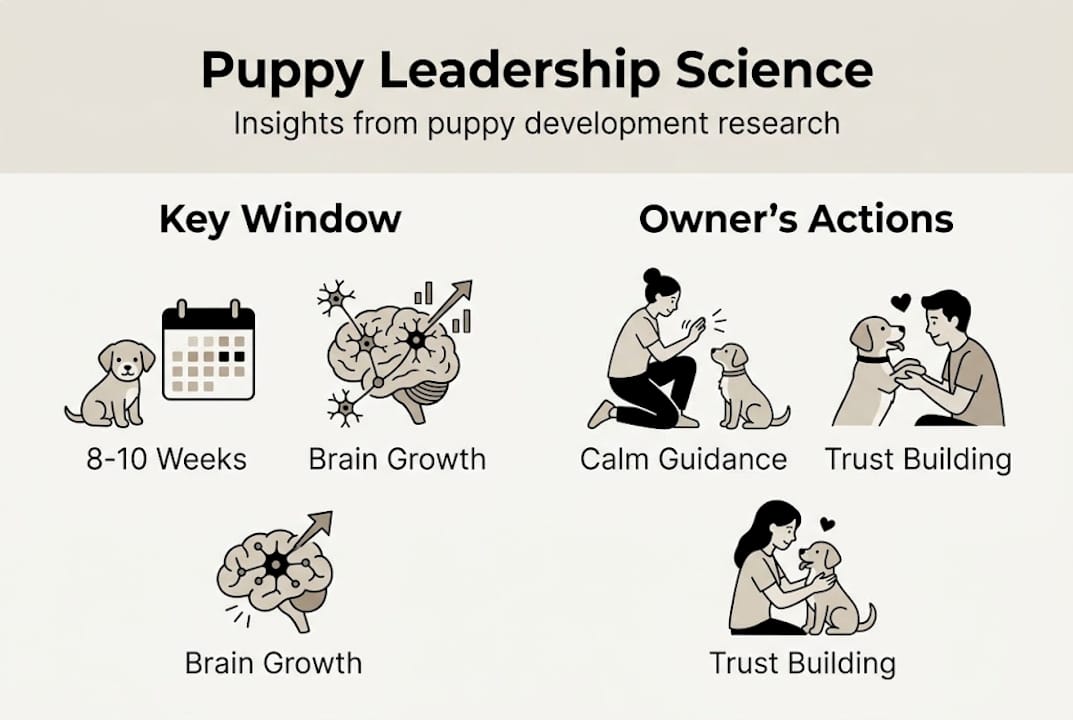
The window between 8 and 10 weeks is particularly significant. This is when puppies are most neurologically receptive to new experiences, relationships, and learning. Starting early puppy training during this period sets the tone for everything that follows.
Key scientific findings on puppy leadership
| Finding | What it means for you |
|---|---|
| Puppies defer to humans from 3 to 8 weeks | Your puppy is already predisposed to follow your lead |
| Positive methods produce faster learning | Reward-based training gets results more quickly than punishment |
| AVMA and AVSAB endorse positive techniques | The science is settled: gentle methods are best practice |
| Strong bonds reduce anxiety | A secure puppy is a calmer, more confident puppy |
The AVMA and AVSAB both endorse positive reinforcement over dominance techniques, and the data backs this up consistently. Puppies trained with rewards show measurably lower stress levels and better long-term behavioural outcomes.
To begin building positive leadership from day one, follow these steps:
- Establish a routine from the first morning home, covering feeding, toilet breaks, and sleep times
- Use a calm, clear voice when giving cues, avoiding loud or frustrated tones
- Reward immediately after your puppy does something right, within two to three seconds
- Redirect, do not punish, by calmly moving your puppy away from unwanted behaviour
- End every session positively, even if it means stepping back to an easier task your puppy already knows
For more on understanding how your puppy's social instincts shape its response to leadership, our article on puppy pack behaviour offers useful context.
Practical puppy leadership: everyday examples
Knowing the theory is one thing. Putting it into practice when your puppy is chewing the sofa leg at 7am is quite another. The good news is that effective leadership does not require special equipment or lengthy training sessions. It happens in the small, repeated moments of everyday life.
Starting on day one with consistency is the single most powerful thing you can do. Puppies learn through repetition and predictability. When your responses are consistent, your puppy builds a mental map of the world that reduces anxiety and builds genuine confidence.
Here is what that looks like in practice:
- Before meals: Ask for a simple "sit" before placing the bowl down. This is not about dominance. It is a calm, daily ritual that reinforces your role as the provider
- At doorways: Step through first and ask your puppy to wait briefly. This builds impulse control without any confrontation
- During play: Initiate and end play sessions yourself. This keeps you in a leadership role without being restrictive
- When misbehaviour happens: Calmly remove your puppy from the situation or redirect attention to an appropriate toy. No shouting, no drama
- At bedtime: Follow a consistent wind-down routine so your puppy learns to settle on cue
Pro Tip: If your puppy jumps up or nips, the most effective response is to turn away completely and withdraw your attention. Puppies seek engagement above almost everything else, and removing it is far more powerful than any reprimand.
Our puppy obedience guide covers these daily techniques in greater depth, and if you are struggling with an unsettled puppy, our resource on calming a new puppy offers targeted advice.
Adapting leadership to your puppy's personality
Not all puppies are the same, and the most effective leaders adapt their approach to suit the individual dog in front of them. Treating a timid, anxious puppy the same way you would treat a bold, energetic one is a common mistake that can undermine even the best intentions.
Adapting your style to your puppy's personality is not about lowering your expectations. It is about choosing the right path to the same destination.
Leadership approach by puppy personality
| Puppy type | Key challenge | Leadership approach |
|---|---|---|
| Shy or anxious | Easily overwhelmed | Gradual exposure, quiet praise, no pressure |
| Bold and energetic | Easily distracted, tests limits | Structured games, short focused sessions |
| Stubborn or independent | Slow to respond to cues | High-value rewards, extra patience, short tasks |
| Eager to please | Can become over-reliant | Encourage independence, vary rewards |
For shy puppies, gradual exposure is everything. Introduce new people, sounds, and environments slowly and at your puppy's pace. Flooding a nervous puppy with too much too soon creates lasting anxiety rather than confidence. Keep early sessions short, end on a positive note, and let your puppy approach new things rather than pushing it forward.
For energetic puppies, structure is your best friend. Channel that enthusiasm into games that require focus, such as simple nose-work exercises or short recall practice in the garden. Unstructured freedom too early can lead to habits that are genuinely difficult to undo.
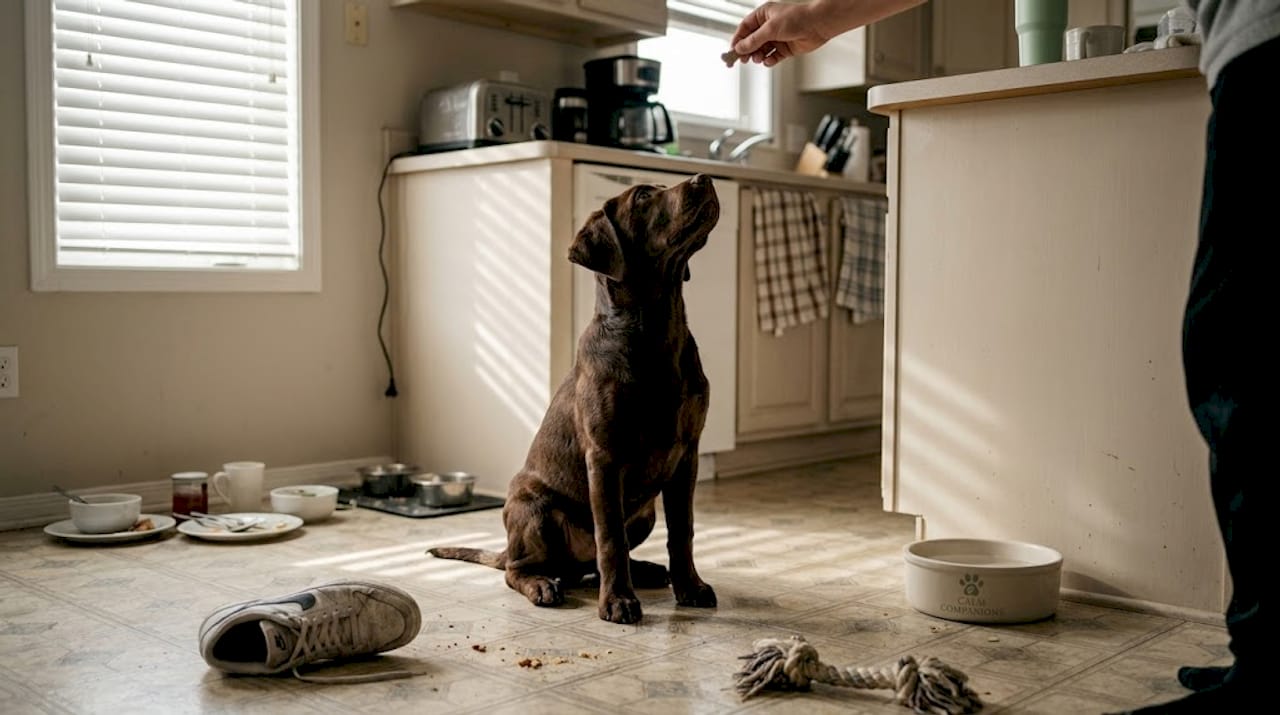
Pro Tip: Whatever your puppy's personality, avoid giving too much freedom in the first few weeks. A smaller, predictable environment helps your puppy settle faster and gives you more opportunities to reinforce good behaviour naturally.
To build a bespoke leadership routine, try this approach:
- Observe your puppy for two to three days before introducing formal training
- Note whether it is more motivated by food, play, or praise
- Choose the time of day when your puppy is calm but alert for short sessions
- Tailor the pace of new introductions to your puppy's comfort level
- Review and adjust weekly as your puppy grows in confidence
Our guides on calm puppy practical steps and puppy behaviour management can help you fine-tune your approach.
Why old 'dominance' methods fail and gentle leadership works
Here is something most training articles will not tell you directly: the reason dominance methods feel satisfying to use is precisely why they do not work. They give the owner a sense of control in the moment. But that feeling is an illusion.
The dominance model was built on flawed science, and applying it to puppies creates fear, not respect. A puppy that complies out of fear is not a confident, well-adjusted dog. It is a dog waiting for the next threat. That anxiety tends to surface later as aggression, resource guarding, or chronic stress.
Gentle, consistent leadership does the opposite. It builds a puppy's trust in you as a safe, reliable presence. Positive methods produce faster learning and measurably stronger bonds, which means you get better results and a happier dog.
The owners who struggle most are usually those trying hardest to be "in charge." The owners who succeed are the ones who focus on being trustworthy rather than dominant. That shift in thinking changes everything. For a deeper look at building that trust from the start, our guide on calm and trust in puppies is a great place to continue.
Find expert support for puppy leadership
Putting all of this into practice during your puppy's first week at home can feel overwhelming, especially when you are sleep-deprived and second-guessing every decision. That is exactly why we created Calm-Companions.
Our puppy help resources are designed specifically for new puppy owners navigating those critical early days. From routines to night settling to redirecting unwanted behaviour, we cover the moments that matter most. Start with our free week-1 puppy checklist, which gives you a clear, day-by-day plan to follow from the moment your puppy arrives. You can also explore our puppy essentials section for practical tools that support calm, confident leadership right from the start.
Frequently asked questions
How is puppy leadership different from dominance training?
Puppy leadership uses consistent, positive guidance to build trust and security, whereas dominance training relies on control rooted in outdated and now debunked wolf behaviour studies. One creates confidence; the other creates fear.
Can gentle leadership prevent future behaviour problems?
Yes. Everyday guidance builds trust and reduces anxiety, which is the root cause of most unwanted behaviours in young dogs. Starting gently and consistently from day one makes a measurable difference.
What is the best age to begin puppy leadership?
The ideal window is 8 to 10 weeks, when puppies are most receptive to learning and naturally inclined to defer to human guidance. The earlier you start, the stronger the foundation.
How should I adjust leadership for a shy puppy?
Use calm, gradual exposure to new experiences and give your puppy extra time to process each new situation. Avoid overwhelming environments in the first few weeks and always let your puppy set the pace.