
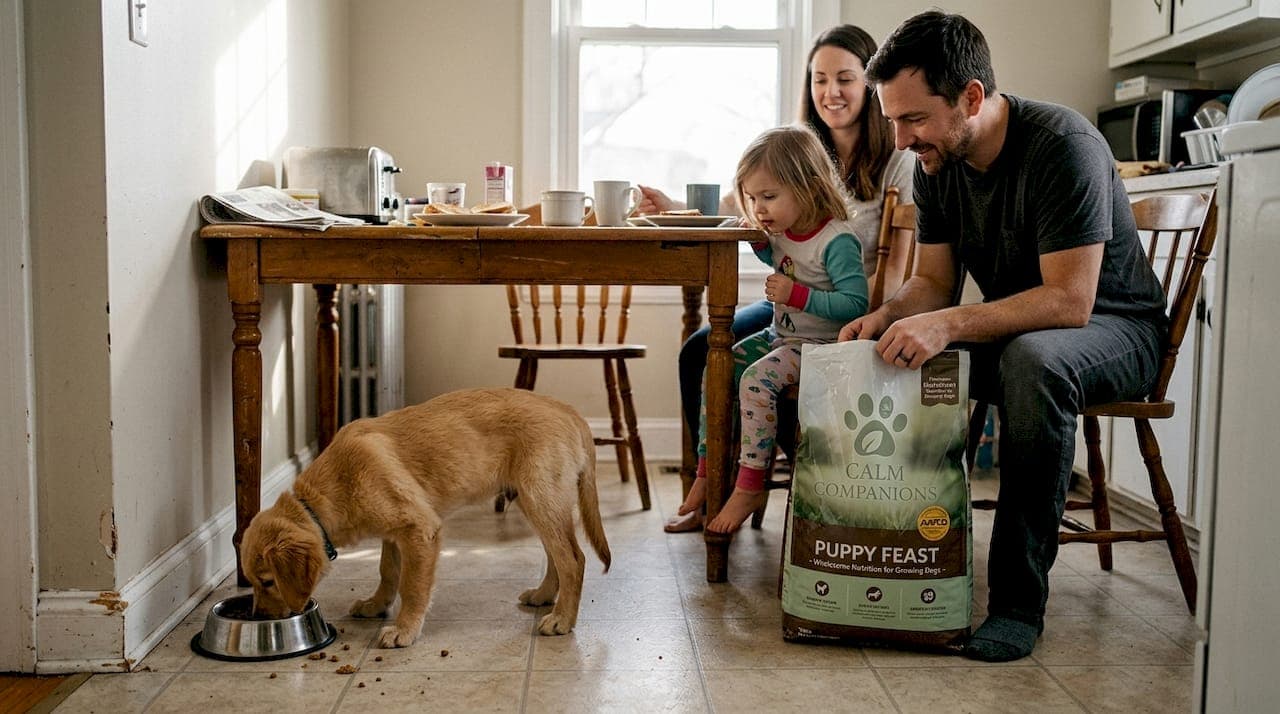
TL;DR:
- Choosing breed-specific, evidence-based puppy food supports healthy growth and development.
- Establishing a consistent feeding schedule and monitoring body condition ensure proper nutrition.
- Gradual food transitions and attentive observation prevent digestive issues and promote well-being.
Bringing a new puppy home is exciting, but the moment you start researching what to feed them, the conflicting advice can feel paralysing. One source says raw food is best, another insists on kibble, and the bag on the shelf promises everything your pup could ever need. The truth is, getting feeding right from the start genuinely shapes your puppy's lifelong health, from their joints and coat to their brain development and digestion. This guide cuts through the noise with evidence-based advice on choosing the right food, building a feeding schedule, handling food transitions, and monitoring your puppy's growth so you can feel confident every mealtime.
Table of Contents
- Choose the right puppy food
- How often and how much: feeding schedule and portions
- Transitioning foods and weaning: the smooth approach
- Monitoring your puppy's growth and avoiding common mistakes
- Our take: why there's no 'one-size-fits-all' for puppy nutrition
- Get ongoing support for your puppy's healthy start
- Frequently asked questions
Key Takeaways
| Point | Details |
|---|---|
| Prioritise puppy-specific food | Always select food meeting AAFCO growth standards and tailored to your puppy’s breed size for the healthiest start. |
| Follow age-appropriate schedules | Adjust meal frequency and portions as your puppy grows to support both nutrition and routine. |
| Transition foods gradually | Switch foods over one week to avoid stomach upsets and monitor weight gain during key transitions. |
| Monitor body condition | Feel for ribs and look for a visible waist to ensure your puppy is neither overweight nor undernourished. |
Choose the right puppy food
Picking the right food is the single most important feeding decision you will make. Puppies are not small adult dogs. Their bodies are growing at a rapid pace, and they need a diet specifically designed to support that growth, not just maintain it.
The first thing to look for on any bag or tin is confirmation that the food meets AAFCO standards for growth, which require at least 22.5% protein and 8.5% fat. AAFCO stands for the Association of American Feed Control Officials, and their nutritional profiles are the benchmark most vets and nutritionists use to judge whether a food is genuinely complete for a growing puppy. You will find this information in the "nutritional adequacy statement" on the label, usually in small print near the bottom.
Breed size matters enormously here. Large breeds like Labradors and Golden Retrievers need formulas with controlled calcium levels to prevent their bones from growing too quickly, which can cause painful joint problems later. Small breeds like Chihuahuas and Toy Poodles have faster metabolisms and benefit from energy-dense, smaller-kibble formulas. The table below shows the key differences:
| Feature | Large breed formula | Small breed formula |
|---|---|---|
| Calcium level | Controlled (lower) | Standard |
| Kibble size | Larger | Smaller |
| Calorie density | Moderate | Higher |
| Typical breeds | Labrador, German Shepherd | Chihuahua, Shih Tzu |
One area where many owners go wrong is grain-free diets. Despite the marketing appeal, grain-free foods have been linked to dilated cardiomyopathy (DCM), a serious heart condition, and DHA-rich formulas are far better supported by evidence for brain and eye development. DHA is an omega-3 fatty acid found naturally in fish oil and is critical during the early weeks of a puppy's life.
When reading a label, look for these:
- Named meat protein first (e.g. chicken, salmon, lamb)
- DHA or fish oil listed in ingredients
- AAFCO growth statement on the packaging
- No artificial preservatives such as BHA or BHT
Avoid foods where "meat meal" or "animal derivatives" are the primary protein source, or where the first ingredient is a grain or filler.
"Foods with DHA support healthy brain and eye development in puppies, making ingredient quality just as important as the nutritional label."
Pro Tip: When you are choosing puppy food, flip the bag over and find the nutritional adequacy statement before anything else. If it does not say "formulated for growth" or "all life stages," put it back on the shelf.
How often and how much: feeding schedule and portions
With the right food in hand, the next step is to establish a feeding schedule and portion control. Puppies have small stomachs and fast metabolisms, which means they need to eat more frequently than adult dogs. Getting the frequency right prevents energy crashes, digestive upsets, and the kind of desperate hunger that leads to gobbling food too fast.
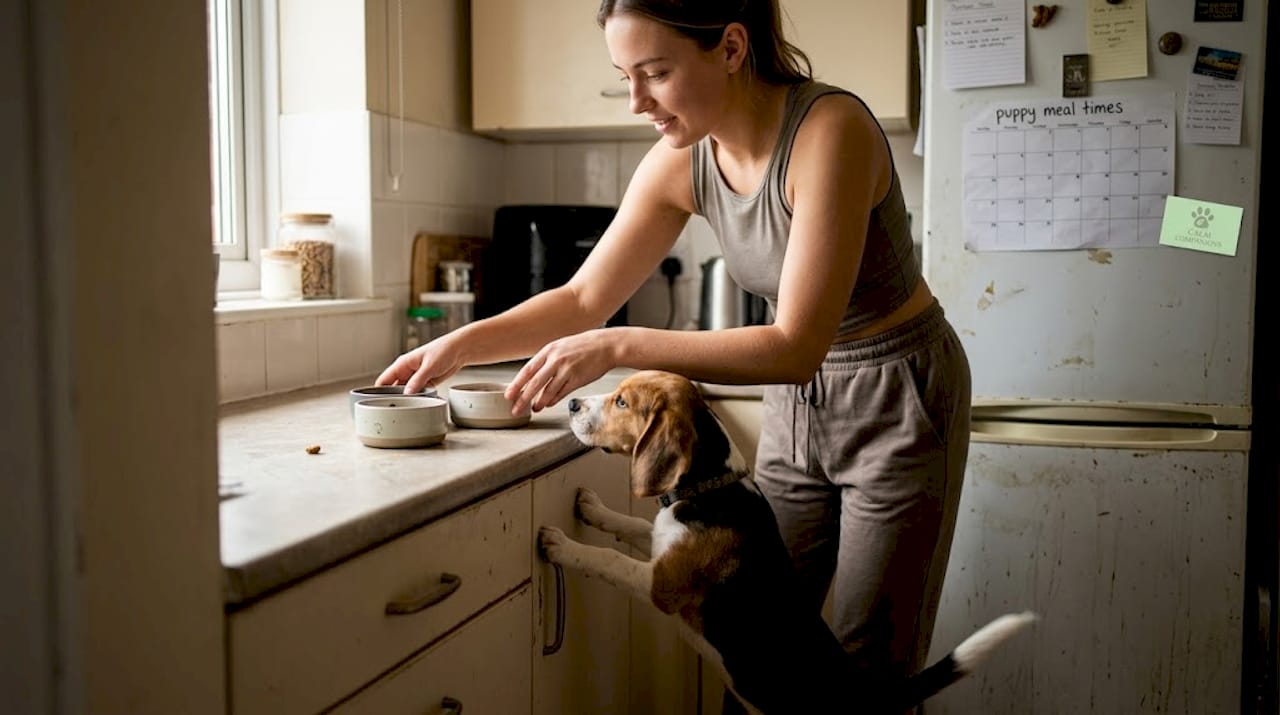
Here is the standard feeding schedule by age that most vets recommend:
| Age | Meals per day |
|---|---|
| 6 to 12 weeks | 4 meals |
| 3 to 6 months | 3 meals |
| 6 to 12 months | 2 meals |
Small breeds may need to stay on three meals a day for longer, as they are more prone to low blood sugar between meals.
For portion sizes, the packet guidelines are a starting point, not gospel. A more accurate approach uses the body condition score (BCS), which rates your puppy's physique on a scale of 1 to 9, with 4 to 5 being ideal. The Resting Energy Requirement (RER) formula gives you a more tailored figure. Multiply your puppy's weight in kilograms by 70, then raise that to the power of 0.75 to get their baseline calorie need. From there, apply a multiplier: 3x for puppies aged 8 to 16 weeks, 2.5x for 4 to 6 months, and 2x for puppies over 6 months.
Here is a simple process to get portions right:
- Weigh your puppy weekly using a consistent scale
- Calculate their RER using the formula above
- Check the food's calorie content per 100g on the label
- Divide the daily calorie target across the number of meals
- Adjust up or down based on their body condition score
Consistency in your puppy feeding schedule also supports training. Puppies who eat at the same times each day develop predictable toilet habits, which makes house training significantly easier. The routine feeding benefits extend beyond digestion, helping your puppy feel secure and settled.
Pro Tip: Use a portion of your puppy's daily kibble allowance as training treats. This keeps their total calorie intake on track and makes every training session feel rewarding without overfeeding.
Transitioning foods and weaning: the smooth approach
Once you understand feeding schedules, it is time to master the art of food transitions and weaning. Whether you are bringing home a very young puppy still adjusting to solid food, or switching brands because your vet has recommended something different, the pace of change matters enormously.
Weaning typically begins at 3 to 4 weeks of age when breeders introduce a gruel made from soaked puppy kibble mixed with water or puppy milk replacer. By 8 to 9 weeks, most puppies are fully eating solid food. If you are adopting a puppy at 8 weeks, ask the breeder what food they have been using and try to continue with the same brand initially.
When you do need to switch foods, do it gradually. A 7 to 10 day transition is the standard recommendation, moving through these stages:
- Days 1 to 3: 25% new food, 75% old food
- Days 4 to 6: 50% new food, 50% old food
- Days 7 to 9: 75% new food, 25% old food
- Day 10 onwards: 100% new food
Rushing this process is one of the most common causes of digestive upset in puppies. Signs to watch for include loose stools, vomiting, excessive gas, or a sudden loss of appetite. If any of these appear, slow the transition down further.
For stress-free food transitions, keep the feeding environment calm and consistent. Puppies who are anxious or overstimulated at mealtimes are more likely to eat too fast or refuse food entirely. A quiet spot away from household traffic makes a real difference, particularly during the calming transition period of their first few weeks at home.
Pro Tip: During weaning and food transitions, weigh your puppy every two to three days rather than weekly. Rapid weight loss during this period is a red flag that warrants a vet call, while steady gain confirms the transition is going well. You can find additional support for the soothing weaning process if your puppy seems particularly unsettled.
Monitoring your puppy's growth and avoiding common mistakes
Even with great food and a solid routine, keeping an eye on your puppy's growth and well-being makes all the difference. Many feeding problems do not show up immediately. They accumulate quietly over weeks until your puppy is visibly under or overweight, or showing signs of nutritional imbalance.
The easiest at-home check is the rib test. Run your fingers along your puppy's ribcage. You should be able to feel the ribs clearly without pressing hard, but they should not be visibly jutting out. From above, your puppy should have a visible waist. If the ribs are buried under fat or the waist has disappeared, it is time to reduce portions.
Weigh your puppy weekly and keep a simple log. This takes two minutes and gives you an objective record that is far more reliable than visual assessment alone.
Common mistakes to avoid:
- Free-feeding (leaving food out all day) makes portion control impossible and encourages overeating
- Rapid food changes without a gradual transition cause digestive upsets
- Adding supplements without vet advice can unbalance a complete diet
- Ignoring breed-specific needs leads to under or overfeeding based on generic guidelines
"Watch your puppy, not the dish. The best guide to whether your puppy is eating the right amount is their body condition, energy level, and weekly weight trend."
Overfeeding large breeds increases the risk of joint disease, while underfeeding small breeds can cause hypoglycaemia (low blood sugar), which is a genuine medical emergency. These are not minor concerns. Feeding-related signs of poor feeding can also show up as behavioural changes, so if your puppy seems lethargic, irritable, or unusually anxious around mealtimes, it is worth reviewing their diet.
The most common puppy health mistakes include free-feeding, making rapid food changes, adding supplements without veterinary guidance, and overlooking breed-specific nutritional requirements. Avoiding these four errors alone puts you well ahead of most first-time owners.
Our take: why there's no 'one-size-fits-all' for puppy nutrition
Here is something most feeding guides will not tell you: following the rules perfectly does not guarantee you are feeding your puppy correctly. We have seen owners using premium foods, measuring portions to the gram, and sticking rigidly to schedules, yet their puppy was still underweight or developing a dull coat. Why? Because they were following the plan rather than watching the puppy.
Every puppy is different. A highly active Border Collie pup will burn through calories that would leave a laid-back Basset Hound overweight. A puppy recovering from a stressful rehoming may eat less for the first week, and that is not a feeding failure. It is a normal stress response.
The puppy behaviour management guide we recommend always emphasises observation over prescription. The same applies to feeding. Use the guidelines in this article as your framework, but treat your puppy's body condition, energy, coat quality, and stool consistency as your real feedback loop. Adjust, observe, and adjust again. That is what confident, attentive ownership actually looks like.
Get ongoing support for your puppy's healthy start
Feeding advice is just one piece of the puzzle when you are settling a new puppy into your home. The first weeks involve so much more: sleep routines, toilet training, socialisation, and building trust with a small animal who is trying to make sense of an entirely new world.
At Calm-Companions, we have put together resources specifically designed for new puppy owners navigating exactly this period. Our puppy feeding help section gives you practical, vet-informed guidance you can act on straight away. And if you want a structured week-by-week plan, our free puppy checklist covers feeding, settling, and behaviour in one easy-to-follow guide. Download it today and give your puppy the calm, confident start they deserve.
Frequently asked questions
When should I switch my puppy to adult food?
Large breeds transition between 12 and 24 months, while small breeds are typically ready to switch at 9 to 12 months. Always use breed-specific guidance rather than a one-size-fits-all timeline.
How do I know if my puppy is eating the right amount?
Check that ribs are palpable without a thick fat layer, your puppy has a visible waist from above, and weigh them weekly to track their trend over time.
What foods are dangerous or unhealthy for puppies?
Puppies must never eat chocolate, grapes, or onions, all of which are toxic. Beyond that, avoid grain-free diets due to DCM links, and keep treats to no more than 10% of their daily calorie intake.
How can I help my puppy if they refuse to eat?
Try feeding in a quieter spot, moisten the kibble slightly with warm water, and remove the bowl after 20 minutes to avoid free-feeding habits. If refusal continues beyond 24 hours, consult your vet and watch for other signs of distress.
Why do puppies need different food from adult dogs?
Puppy food provides higher protein and fat levels, at least 22.5% protein and 8.5% fat, along with nutrients like DHA that support rapid brain, eye, and bone development that adult formulas simply do not supply in adequate amounts.